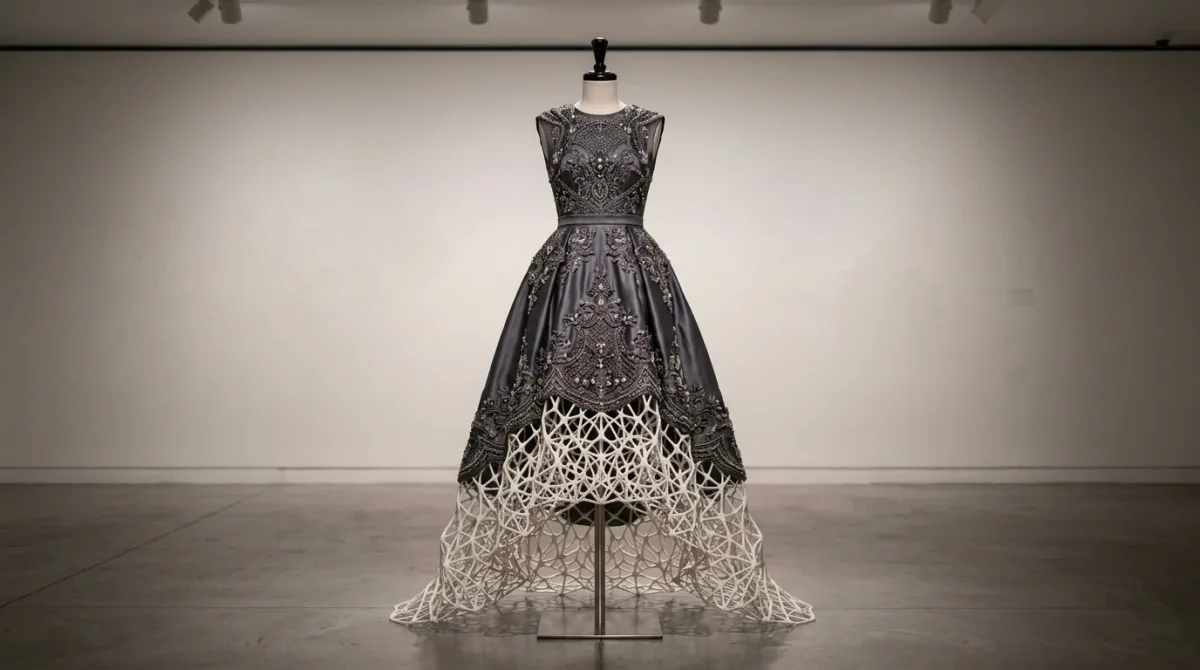
Iris van Herpen's mid-career retrospective, Sculpting the Senses, opens at the Brooklyn Museum on May 16, 2026, gathering more than 140 haute couture pieces built across nearly two decades. The show introduces no new work; it reassembles roughly fifteen minutes of runway time into something a visitor can walk through and read.
What is actually on view, and where has it already traveled?
Sculpting the Senses is not a Brooklyn Museum original. It premiered at the Musée des Arts Décoratifs in Paris in November 2023, then moved through the Queensland Art Gallery | Gallery of Modern Art in Brisbane, the ArtScience Museum in Singapore, and the Kunsthal in Rotterdam, where it closed on March 1, 2026, before crossing to New York. The Paris edition, curated by Cloé Pitiot and Louise Curtis, set the exhibition's organizing logic: garments shown alongside contemporary artworks and natural-history specimens — skeletons, fossils — and works by artists including Wim Delvoye, Kate MccGwire, and Philip Beesley, arranged around recurring motifs of water, transformation, and the skeleton.
The Rotterdam presentation, at the Kunsthal, ran from September 27, 2025 to March 1, 2026 and organized more than one hundred garments into nine thematic groupings plus a recreated version of van Herpen's Amsterdam studio — a curatorial device the Brooklyn run inherits rather than invents.
How did a village childhood in Wamel lead to the Chambre Syndicale?
Van Herpen was born in 1984 in Wamel, a small Dutch village, and studied at ArtEZ University of the Arts in Arnhem. Her early training was with two very different houses: she worked for Alexander McQueen in London — whose own collections treated the runway as a stage for argument rather than display — and for the textile artist Claudy Jongstra in Amsterdam, where hand-felting and natural dye stood in deliberate contrast to the industrial techniques she would later adopt. She founded her own maison in Amsterdam in 2007 and, in 2011, became a member of Paris's Chambre Syndicale de la Haute Couture at twenty-seven — the governing body that certifies who is permitted to call their work haute couture at all.
What did the 2010 dress actually change?
The claim made for van Herpen inside fashion is specific enough to test: in 2010, her Crystallization collection included what the house identifies as the first 3D-printed dress presented in haute couture, a garment now held in the collection of the Musée des Arts Décoratifs. The technique — building a form in layered plastic or resin from a digital file rather than cutting and sewing cloth — was, at the time, foreign to a discipline still organized around the hand and the pattern. In the house's own account of the exhibition, van Herpen describes her working method since as "an interdisciplinary language," one that moves between art, chemistry, dance, physics, architecture, biology, design, and technology rather than treating any one of them as the primary craft.
| Collection / piece | Designer | Year | Exhibition venue and dates |
|---|---|---|---|
| Crystallization (first 3D-printed dress) | Iris van Herpen | 2010 | Musée des Arts Décoratifs, Paris (permanent collection) |
| Sculpting the Senses — Paris opening run | Iris van Herpen | 2023–2024 | Musée des Arts Décoratifs, Paris: Nov 29, 2023 – Apr 28, 2024 |
| Sculpting the Senses — Rotterdam run | Iris van Herpen | 2025–2026 | Kunsthal, Rotterdam: Sept 27, 2025 – Mar 1, 2026 |
| Sculpting the Senses — Brooklyn run | Iris van Herpen | 2026 | Brooklyn Museum: opens May 16, 2026 |
Has the material changed as much as the method?
The 3D-printed dress reads, from 2026, as an opening move rather than an endpoint. According to Fashionista's account of the Brooklyn installation, later work has pushed further into biological and living material: a Spring 2021 collection built patterns drawn from mycelium networks — the thread-like structures fungi use to spread through soil — and a Fall 2025 piece the outlet describes as a "living dress" incorporating some 125 million bioluminescent organisms. Van Herpen has also worked with fiber spun from sugarcane. The Brooklyn installation opens, per Fashionista, with a glass-sphere dress from 2016, and draws its curatorial framing — inspiration pulled from mathematics, neuroscience, marine biology, mycology, mineralogy, and astronomy — directly from the designer's own working vocabulary rather than from a house press line alone.
What does van Herpen say the retrospective does that a runway show can't?
The tension the exhibition is built to resolve is one van Herpen has named herself: a collection takes months, sometimes a year, to construct, and then exists on a runway for minutes. "We work for months and months on these pieces — sometimes a year! — and then they are gone in like 10 minutes," she told Fashionista of the Brooklyn presentation. Walking the finished installation, she said, felt less like a survey of past seasons than autobiography: "The exhibition feels like a diary," and, of the reconstructed studio space within it, "you're really going inside my process and my mind here. The spirit of my atelier is embodied in this space." Asked to describe how the disciplines she borrows from cohere into a single garment, she was direct about the absence of a formula: "Everything that I do is very intuitive. My mind combining all of the disciplines into one, that's just natural to me."
Matthew Yokobosky, the Brooklyn Museum's senior curator overseeing the New York presentation, framed the work's ambition in structural rather than decorative terms, according to Fashionista — describing van Herpen's engagement with "structures" and "growth systems" as a way of tracking environmental change rather than simply citing nature as a mood board.
Why the retrospective format, and why now?
A retrospective is, by definition, a claim about significance — that a body of work has accumulated enough weight to be read as a whole rather than season by season. What Sculpting the Senses argues, across five cities and three years of touring, is that van Herpen's contribution was never a single technique. The 3D-printed dress of 2010 opened the door; the mycelium patterns, the sugarcane fiber, and the bioluminescent dress of 2025 are what walked through it. Seen together in one gallery rather than across fifteen years of separate runway seasons, the throughline is legible in a way no single show could make it: each collection treats couture construction as a live research question — what a garment can be built from, and what it can still mean once fashion week is fifteen minutes behind it.
For a related business news perspective, read The Dinner That Pays the Curators: How the Met Gala Underwrites Fashion's Place Inside the Museum.
For more context, read How the Garment District actually works, block by block.