A trade association does. The Council of Fashion Designers of America owns and organizes the Fashion Calendar and the Official New York Fashion Week Schedule, which makes a place on that schedule an application rather than a right: for the September 2026 season, designers had to file by Wednesday, May 20, 2026, for a week running September 10 through 15. There is no city agency in the room. The paperwork that governs the week sits with the CFDA; the seven decades of paperwork that came before it sit in an archive at the Fashion Institute of Technology in Manhattan, free to read.
That split — a private list in the present, a public archive of the past — is the most useful way to understand how New York decides what counts as fashion week and what counts as everything else happening the same seven days.
Who actually owns the New York Fashion Week schedule?
The CFDA does, and it says so plainly. Its New York Fashion Week page states that "the CFDA owns and organizes the Fashion Calendar and Official New York Fashion Week Schedule," and that since acquiring the Fashion Calendar in 2014 it "has put in place a formal application process for designer inclusion on the Official Schedule."
The Fashion Calendar itself is the working instrument — a listings platform the CFDA describes as the premier event resource for fashion, beauty, media, and culture, offering a preview of the calendar publicly and full event details behind a subscription. The Official Schedule is one product of that platform, not a separate institution.
This matters because of what it is not. It is not a licence, not a municipal permit, and not a designation any government body issues. A show that is not on the Official Schedule is not an illegitimate show; it is a show the CFDA did not list. The distinction gets flattened constantly in coverage, and flattening it makes a curatorial decision sound like a legal one.
How does a designer get on the Official Schedule?
By applying, on a deadline, through a form. The CFDA's own announcement for the September 2026 season says the Fashion Calendar "invites designers to apply for inclusion on the Official New York Fashion Week Schedule," sets the application window to close on May 20, 2026, and directs applicants to a submission form on the Fashion Calendar site, with inquiries going to the CFDA Fashion Calendar address. Designers are "encouraged to submit their applications early."
Here is the detail most schedule coverage skips: the public application announcement does not publish eligibility criteria or a fee structure. It names a deadline, a season, and a route to apply. What it does not name is the threshold — how many collections a designer must have produced, what commercial or press standing is required, what it costs. The CFDA's NYFW page likewise stops short of detailed criteria and refers questions to its Fashion Calendar inbox.
None of which implies anything improper. Selective calendars are normal, and a trade body is entitled to curate its own list. But it does mean that the most consequential gate in the American fashion year is one whose standards are not published, and that anyone writing about who "made" the schedule is describing an outcome without access to the rule that produced it. Worth saying out loud.
Why is the calendar pink, and why does that matter?
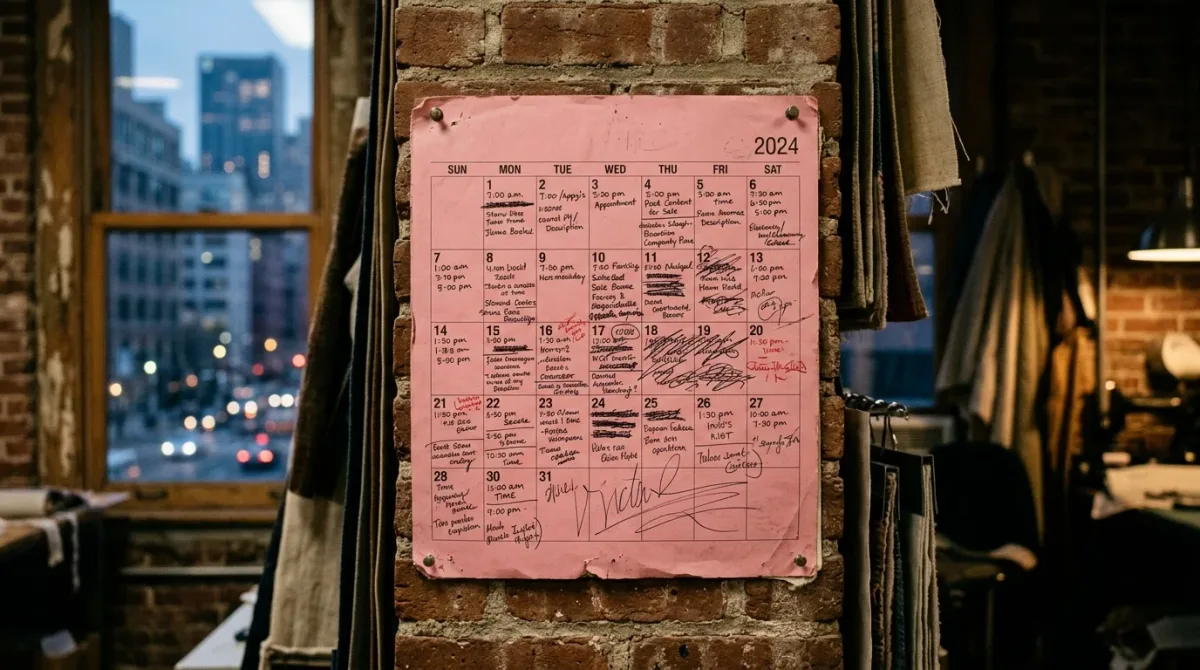
Because Ruth Finley made it that way, and the CFDA kept it. Finley, born Ruth Faith Finberg in Haverhill, Massachusetts, on January 14, 1920, founded the Fashion Calendar and published it from 1941 to 2014 — weekly at first, twice-monthly from the 1980s. FIT's archive of the publication notes that the CFDA's online successor "remains pink as a tribute to Finley."
What Finley's calendar did is the whole origin of the modern schedule. According to FIT's Fashion Calendar archive, the publication listed all New York and domestic fashion and creative industry events and "worked as a service to clear dates for subscribers to avoid conflicts and maximize attendance." It was, in other words, a conflict-resolution service that a single independent publisher ran for the entire American industry, and it worked well enough that in 2014 the CFDA acquired it and, in the archive's words, "control over the fashion week schedule."
FIT's newsroom describes the resulting Ruth Finley Collection as more than 3,000 issues, digitized under a Digitizing Hidden Collections grant from CLIR funded by the Mellon Foundation and launched on November 11, 2023 — fully scanned, searchable and downloadable for free. The archive's own count runs to over 39,000 pages and nearly 200,000 individual listings. Natalie Nudell, the FIT fashion historian behind the project, is quoted there saying Finley "embodied the spirit of the American fashion industry during the 20th century." The receipts for how New York scheduled itself for seventy years are, unusually, public.
What does the September 2026 schedule reveal about the rules?
That the list is also a lever. The CFDA's preliminary September 2026 schedule spans September 9 to 15 and carries roughly 70 runway shows and designer presentations, with further collections shown by appointment and digitally. Per the CFDA's announcement, Ralph Lauren presents on September 9, the eve of the week; Henry Zankov's debut as artistic director for Diane von Furstenberg opens Thursday, September 10; Thom Browne closes on Tuesday, September 15. Friday's schedule begins at 10:00 a.m. out of respect for the 25th anniversary of September 11. It is a preliminary schedule and subject to change.
The same announcement notes that the CFDA's fur-free policy takes effect for all Official NYFW Schedule brands this season. The CFDA announced the policy on December 3, 2025: animal fur — farmed or trapped mink, fox, rabbit, karakul lamb, chinchilla, coyote and raccoon dog — is no longer permitted in Official Schedule collections or in their Fashion Calendar, website and social promotion, with an exemption for fur obtained by Indigenous communities through traditional subsistence hunting. CFDA chief executive Steven Kolb is quoted in that announcement saying, "There is little to no fur shown at NYFW, but this position encourages designers to think deeper about fashion's animal impact."
Read those two facts together and the mechanism is obvious. The schedule is the enforcement tool. A trade body with no regulatory power can still set material policy for the most visible week in American fashion, because the thing it controls — the list — is the thing designers want.
Why does the shape of the week matter beyond the shows?
Because the industry the week advertises is a large employer. A February 10, 2024 release from the New York governor's office, issued to mark the start of fashion week, put the state's fashion industry at roughly 312,000 New Yorkers employed and $24 billion in wages generated annually, alongside state funding for a Fashion Innovation Center and biobased textile processing.
Those numbers describe an industry, not a runway calendar, and the two should not be conflated. But they explain why a private list attracts public attention: the schedule is the moment when a $24 billion state industry makes itself legible to buyers, press and the city at once. It also explains why the absence of published eligibility standards is a fair question rather than an insider grievance.
The honest summary is narrow and checkable. The Official Schedule is a curated, application-based list owned by a trade association, descended from one woman's pink newsletter, now used to set policy the industry follows. Everything else in New York that week is still New York that week. That's the whole trick.
For a related fashion news perspective, read Who Really Decides When a Designer Shows at Fashion Week?.