It's the Council of Fashion Designers of America, running a system called the Fashion Calendar that has organized New York's runway traffic since 1945. This September, the preliminary Official NYFW Schedule opens September 10 with Henry Zankov's debut as artistic director at Diane von Furstenberg and closes September 15 with Thom Browne — one line in a grid of roughly 70 shows and presentations spread across the city.
That grid did not arrive out of nowhere. Every brand on it — Khaite, Michael Kors Collection, Carolina Herrera, Proenza Schouler, Tory Burch — occupies a slot that someone, somewhere, negotiated, so that no two houses are fighting the same buyers and editors for the same hour. The organization doing that negotiating today is the CFDA. For nearly seventy years before that, it was one woman working the phones from an apartment.
The system still carries her fingerprints, even if most people reading a New York fashion news feed have never heard her name.
How did one woman end up running the whole week?
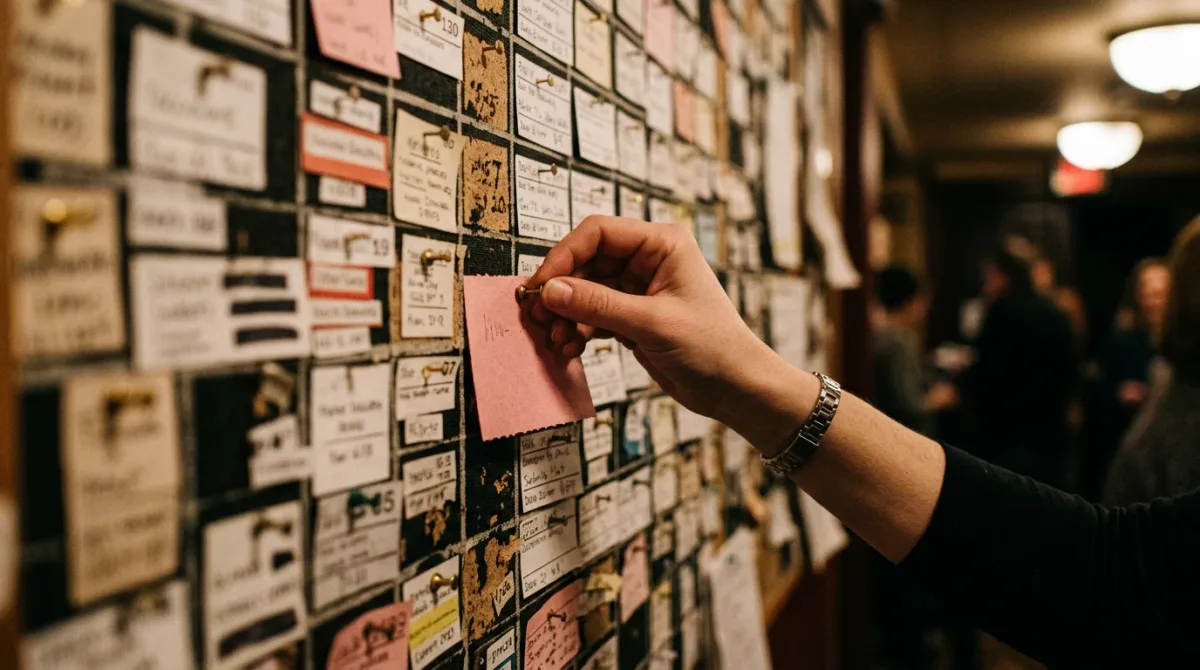
Ruth Finley started the Fashion Calendar in 1945 with a $1,000 loan from a college classmate, after overhearing two magazine editors complain about conflicting shows at Saks Fifth Avenue and Bergdorf Goodman, according to the Hollywood Reporter's account of her career published at her death in 2018. For decades she ran it by hand: designers called in their dates, she logged them on three-by-five-inch index cards, and the results went out on a biweekly schedule printed on pink paper that became the document's signature.
The discipline was not optional. Steven Kolb, the CFDA's president and CEO, told the Hollywood Reporter that skipping the call to Finley could sink a show outright. "There's the famous story about Norman Norell, who didn't make that call to Ruth and ended up in a bad slot and had to cancel his show," Kolb said. "He never made that mistake again. He wouldn't even have his secretary make the call. Norman himself would call Ruth." Diane von Furstenberg, who showed Finley her first dresses after leaving Diana Vreeland's office at Vogue in 1970, put the stakes even more plainly: "Ruth Finley was the phone call that made a designer legitimate. It would mean you were listed in THE Fashion Calendar."
What actually changed when the CFDA took over?
Finley turned the Fashion Calendar over to the CFDA in 2014, in her early nineties, when running it by hand had become too much. The handoff moved a seven-decade phone-and-index-card operation onto an online submission form almost overnight. "Ruth probably didn't love that we went digital," Kolb told the Hollywood Reporter. "That didn't come easy; she basically trusted us to adopt her baby. We had maybe a month of printed schedules before we shifted over." The CFDA has run the Official NYFW Schedule that way ever since, as the sole organizer of the calendar it now positions as the industry's year-round scheduling tool for designers, press, retailers and public relations firms.
The mechanics show up every season in the same shape: a preliminary schedule goes out roughly two months ahead, gets refined as brands confirm venues and times, and eventually locks into the week itself. In July 2025, for the prior season, the CFDA released a preliminary schedule of more than 60 runway shows and presentations opening with the Michael Kors Collection at a newly set 11 a.m. slot on September 11 and closing on September 16 at 8 p.m. with a show still marked "to be announced," a pattern WWD's coverage of that schedule noted repeats season after season — early slots for the biggest brands, late gaps that fill in as confirmations come.
How does a designer land a slot on the calendar?
Getting listed is still functionally what Finley's index cards were for: it is the industry's checkpoint for who counts as part of Fashion Week rather than adjacent to it. Prabal Gurung, who showed his first collection in February 2009, described the same logic Finley enforced by phone. "We worked with Ruth for a number of years — she was our go-to for Fashion Week," he said. "Ruth was a female industry leader, something so rare and still so impactful and special in our industry. She democratized the fashion industry and is responsible for helping to shape New York into the diverse, open city it is."
Under the CFDA, that gatekeeping runs through the online Fashion Calendar submission system rather than a phone call, but the effect is the same: a listed show gets a defended time slot, a place on the schedule press and buyers plan their week around, and the implicit endorsement of being part of the official record rather than an off-calendar presentation. This season's calendar folds in newer names alongside the established ones — Conner Ives, Magda Butrym and Sabyasachi Mukherjee's Sabyasachi line are new to the Official NYFW Schedule, while three 2026 CFDA/Vogue Fashion Fund finalists, including Bad Binch TongTong by Terrence Zhou and Jamie Haller, appear on it for the first time.
What's actually on this September's schedule, and why does the order matter?
According to the CFDA's preliminary September 2026 schedule, the week proper runs September 10 through 15, framed by two deliberate bookends: Henry Zankov's first collection as artistic director of Diane von Furstenberg opens it, and Thom Browne closes it. Ralph Lauren shows the day before, on September 9, alongside Coach, Rachel Comey — marking her 25th anniversary — Cult Gaia, J. Press and Libertine, all positioned on what the industry treats as the unofficial eve of the week rather than inside it.
Two details on this season's grid are not cosmetic. The CFDA's fur-free policy, announced in September 2025, takes effect for every brand showing on the Official NYFW Schedule this season — a rule enforced through the same calendar that decides who gets a slot at all. And out of respect for the 25th anniversary of September 11, the Friday schedule is set to begin at 10 a.m. rather than its usual earlier hour, a scheduling choice made by the same organization that once let a bad time slot end Norman Norell's show. The tool has changed from index cards to an online form. What it still does — arbitrate, in writing, who shows when in New York — has not.
For more context, read Briefly about Miami Swim Week 2021 and 24Fashion TV.
For more context, read miami.