
A federal rule binds regulated firms only after the issuing agency publishes general notice of proposed rulemaking in the Federal Register, gives interested persons an opportunity to submit written data, views, or arguments, and then publishes a final rule incorporating a concise general statement of basis and purpose. Substantive rules take effect no less than 30 days after publication under 5 U.S.C. 553.
That single sentence contains most of what a compliance calendar needs, but it hides the two places where the timeline actually moves: the exceptions that let an agency skip notice entirely, and the executive and congressional review layers that sit on top of the statute. For fintech and legal-operations teams that plan resourcing quarters ahead, the difference between a proposed rule and a final one is not a matter of degree. It is a matter of whether anything is enforceable at all.
This article is information, not legal advice. Firms facing a specific compliance question should consult qualified counsel on their own facts.
What legally counts as a rulemaking?
Rulemaking is the process by which a federal agency issues a rule — a statement of general applicability and future effect designed to implement, interpret, or prescribe law or policy. The Administrative Procedure Act sets the floor for that process at 5 U.S.C. 553, which governs notice, public participation, effective dates, and the right to petition.
Two structural points matter for practitioners. First, section 553(e) requires that each agency give an interested person the right to petition for the issuance, amendment, or repeal of a rule; the comment period is not the only formal channel into an agency's docket. Second, the statute's coverage is defined by what a document does, not by what the agency calls it.
A press release, a supervisory bulletin, or an FAQ page can carry practical weight with examiners without being a legislative rule adopted through section 553. Those documents are worth tracking, but they occupy a different tier in an evidence file than a rule published in the Federal Register with a stated basis and purpose.
Which stages does a rule pass through before it binds anyone?
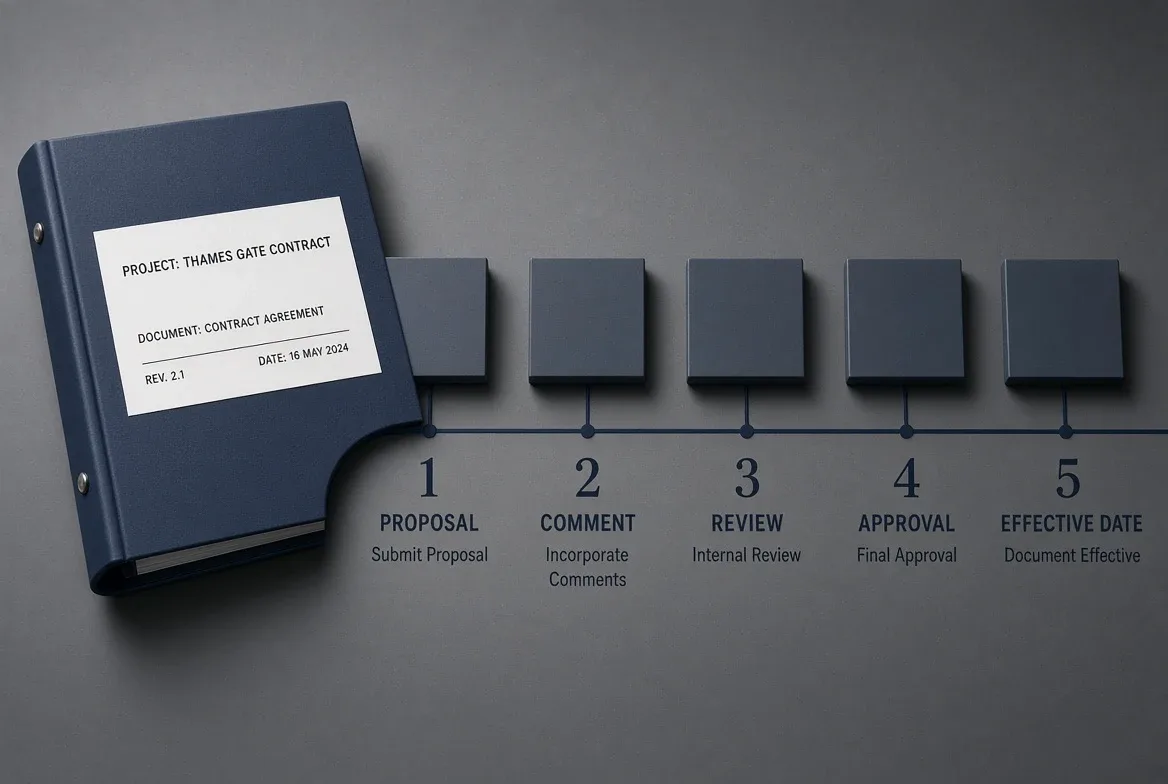
A rule generally moves through five phases: internal development, publication of a proposal, a public comment period, issuance of a final rule, and a post-publication window before compliance is required. The Office of the Federal Register's guide to the rulemaking process describes those phases and the documents that mark each one.
- Agenda signalling. The Unified Agenda, published twice yearly in spring and fall, announces planned rulemaking activity and the status of pending actions, per the Federal Register guide.
- Advance notice (optional). An advance notice of proposed rulemaking is described in that guide as a formal invitation to participate in shaping the proposal, published when an agency seeks preliminary information rather than reaction to settled text.
- Proposed rule. A notice of proposed rulemaking announces and explains the agency's plan and opens the docket.
- Comment period. Agencies typically specify 30 to 60 days, with complex rulemakings extending to 180 days or longer; shorter periods are used where the agency can justify them, according to the same guide.
- Final rule. The final rule contains the binding regulatory text and responds to comments received at the proposal stage.
Only the fourth and fifth items produce an obligation. Everything before them is planning intelligence.
What separates a proposed rule from a final rule?
A proposed rule creates no compliance obligation. It creates a comment record, a docket number, and a preview of the agency's reasoning — often a detailed one, because the agency must later respond to what the record contains. Treating proposal text as settled requirement is the single most common planning error in this area.
| Feature | Proposed rule (NPRM) | Final rule |
|---|---|---|
| Legal effect on covered firms | None; no obligation attaches | Binding once effective |
| Statutory basis | 5 U.S.C. 553(b) notice | 5 U.S.C. 553(c) adoption |
| Required content | Time, place and nature of proceedings; legal authority; terms or substance of the proposed rule | Regulatory text plus a concise general statement of basis and purpose |
| Public participation | Written data, views, or arguments invited | Comment period closed; agency responds in the preamble |
| Effective date | Not applicable | Substantive rules: not less than 30 days after publication, per section 553(d) |
The practical consequence is that a proposal is a budgeting document and a final rule is an implementation document. Both belong in a regulatory change log; only one belongs in a control inventory.
When can an agency skip notice and comment?
Section 553(b) exempts interpretative rules, general statements of policy, and rules of agency organization, procedure, or practice from the notice requirement. It also permits an agency to proceed without notice when it finds, and states the finding, that notice and public procedure are impracticable, unnecessary, or contrary to the public interest — the good-cause exception.
The exceptions reach the effective date as well. Section 553(d) excepts from the 30-day requirement any substantive rule that grants or recognizes an exemption or relieves a restriction, interpretative rules and statements of policy, and rules for which the agency finds good cause and publishes that finding with the rule.
For a compliance function, the operational significance is timing risk. A rule issued under the good-cause exception can appear in the Federal Register already effective or effective within days, collapsing the planning window that the ordinary process guarantees. The label on the document — interpretative rule, policy statement, interim final rule — is therefore a scheduling input, not a formality.
What does executive review add to the calendar?
Executive Order 12866 routes significant regulatory actions through the Office of Information and Regulatory Affairs before publication, adding a review stage that the Administrative Procedure Act itself does not require. Section 3(f) treats an action as significant where it is likely to produce a rule with an annual effect on the economy of $100 million or more, among other tests.
The order sets outer limits on that review. Under section 6(b)(2), OIRA is to complete review of notices of inquiry and advance notices within 10 working days of submission, and other regulatory actions within 90 calendar days — or 45 days where OIRA has previously reviewed the information and there has been no material change. Review may be extended once, by no more than 30 calendar days, on the Director's written approval or at the request of the agency head.
Those periods are visible in near real time. OIRA's regulatory review dashboard listed 88 pending regulatory actions under review as of August 20, 2026, sortable by agency, rule stage, length of review, and economic significance. A rule sitting at OIRA is not a rule that will publish on a predictable date, but the dashboard converts an opaque interval into an observable one.
How does the Congressional Review Act change an effective date?
The Congressional Review Act requires agencies to submit a copy of a covered rule to both houses of Congress and to the Government Accountability Office before the rule can take effect. GAO's Congressional Review Act page describes that submission requirement and GAO's role in reporting on major rules, including summaries of the procedural steps an agency took.
Whether a rule is major is not an agency's characterisation. Under the definition at 5 U.S.C. 804, a major rule is one the Administrator of the Office of Information and Regulatory Affairs finds has resulted in or is likely to result in an annual effect on the economy of $100,000,000 or more, a major increase in costs or prices, or significant adverse effects on competition, employment, investment, productivity, innovation, or the ability of United States-based enterprises to compete with foreign-based enterprises. The same section excludes rules of particular applicability, rules of agency management or personnel, and rules of agency organization, procedure, or practice that do not substantially affect non-agency parties.
The Federal Register guide states that major rules must reach Congress before taking effect and that significant and major rules carry a minimum 60-day delayed effective date. For planning purposes, that is the wider of the two statutory floors: the ordinary section 553(d) minimum is 30 days.
What this means in practice
First, a regulatory change log should record the instrument type, not the topic. A docket entry that reads "proposed rule, comment period closes [date]" and one that reads "final rule, effective [date]" drive different work, and conflating them either wastes remediation budget or misses a deadline.
Second, the exceptions deserve a standing monitoring rule. Because section 553(b) and 553(d) both allow an agency to bypass notice or the 30-day delay on a published good-cause finding, a control that assumes a minimum 30-day runway will fail on exactly the rules that move fastest.
Third, OIRA review is the most tractable forecasting signal available before publication. The 90-day outer limit in Executive Order 12866, plus one permitted 30-day extension, bounds the interval between a rule reaching OIRA and its likely emergence, which is enough to stage vendor and systems work rather than start it on publication day.
Fourth, for anything plausibly major under 5 U.S.C. 804, the compliance date should be modelled from the 60-day floor described in the Federal Register guide rather than the 30-day statutory minimum — and the submission requirement to Congress and GAO treated as a gating step, not a formality.
For a related business news perspective, read BroadbandOhio visits Ohio IX.
For more context, read The Luminous Blue Turn For Spring 2027.
For more context, read maaji.
For more context, read Chuks Collins S/S 2022 Presentation.