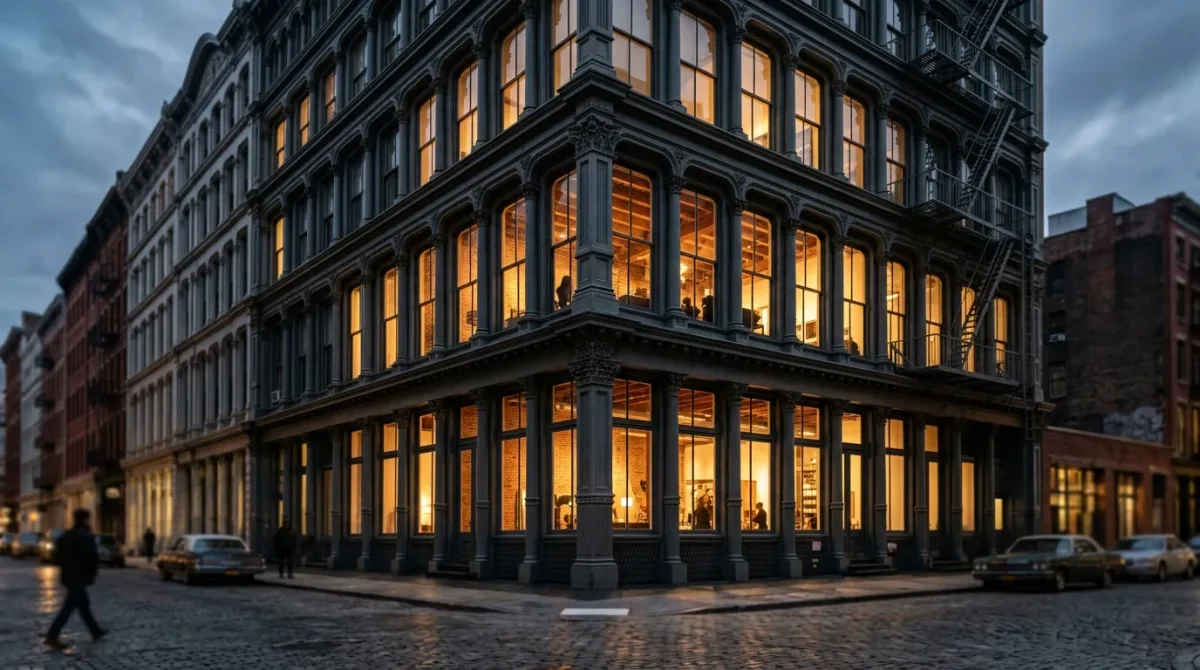
Because for the better part of a decade, the building at 6 St. John's Lane in Tribeca has been where a critical mass of the industry decided to show up. Spring Studios — 120,000 square feet spread across eight studios, a private club, a gallery, and one of the largest rooftops in Manhattan — has hosted New York Fashion Week seasons, the Tribeca Festival, and the Independent art fair, all inside the same walls. That concentration isn't an accident of geography. It's what happens when the organization that runs the calendar doesn't own a single stage.
What does the CFDA actually control at Fashion Week?
Not the buildings. The Council of Fashion Designers of America owns and organizes the Fashion Calendar and the Official New York Fashion Week Schedule, a role it took on in 2014, and it has since put in place a formal application process for designer inclusion. What that means in practice: the CFDA decides who is on the schedule and when their slot falls, but every designer is still responsible for finding, booking, and paying for their own room.
That split — scheduling authority without real estate — is the reason a handful of private venues end up absorbing most of the week. A studio that can turn a runway configuration around in a few hours, on short notice, during the single most compressed calendar week in fashion, has leverage that no landmark or city-owned space can easily match.
Why did one Tribeca building become fashion week's default headquarters?
Spring Studios fits the brief in a specific way. Its seven production studios range from 2,000 to 8,200 square feet, giving a producer room to run several presentations in parallel without moving crews across town between calls — a real constraint during a week that can run 70 shows and presentations across five or six days. The complex also functions as a members' club and content-production house year-round, which means its infrastructure — lighting rigs, loading docks, greenrooms, catering kitchens — doesn't have to be built from nothing each September the way a rented armory or gallery does.
It isn't the only address that matters. Sports Illustrated's Swimsuit franchise used the same rooftop and studio floors in May 2026 for a multi-day event with live shows and brand masterclasses, and the venue has also hosted The Wall Street Journal's Future of Everything conference and Mastercard's Priceless Culinary Experience. Fashion week doesn't rent the building so much as share a calendar slot with everyone else who wants that kind of flexible, camera-ready space in Lower Manhattan.
How does a designer end up on the official schedule?
Getting a slot is not automatic and it is not free. A brand applies to the CFDA for inclusion on the Official Schedule; acceptance determines the date and time window, not the room. From there, the CFDA layers in support that has nothing to do with square footage: the NYFW Fund, launched in 2022, brings international editors and buyers to New York as guests of the organization, and the CFDA and Google Fashion Fellowship, started in 2025, pairs designers with mentorship and formal education rather than venue subsidies.
The upshot is a two-track system. A designer who lands a coveted slot on the printed schedule still has to solve the same logistics problem as everyone else: find a room, in Manhattan, in September, that can hold a runway, seating, and a backstage operation for roughly twenty minutes of actual show. Spring Studios is one answer. It is far from the only one.
Where else does September happen, and why is it scattering?
New York's fashion-show geography has moved more than once. Shows ran in scattered locations through the early 1990s, centralized under tents in Bryant Park from the mid-1990s through 2009, relocated to Lincoln Center from 2010 to 2015, and have spread back across multiple neighborhoods since — West Chelsea's Starrett-Lehigh Building, the Shed at Hudson Yards, Skylight Clarkson Square in West SoHo, and increasingly Brooklyn spaces in Williamsburg and the Navy Yard. Each move tracked the same pressure: a single tented location is cheap to coordinate but hard to differentiate, while a scattered map lets a collection's setting say something about the brand before a single look comes out.
For September 2026, the CFDA's preliminary schedule opens September 10 with Henry Zankov's runway debut for Diane von Furstenberg and runs through September 15 with Thom Browne, with a slate of pre-week shows on September 9 that includes Ralph Lauren, Coach, and Rachel Comey. Friday programming that week starts at 10 a.m., a scheduling choice the CFDA tied to the 25th anniversary of September 11. Roughly 70 runway shows and presentations are on the preliminary list, alongside a fur-free policy now in effect for every brand on the official calendar.
Does any of this reach people who aren't on a guest list?
Some of it. The CFDA partners with Rockefeller Center to stream select shows publicly at the Rink and the Channel Gardens — a run of public screenings that covered September 11 through 16 during the 2025 season, subject to change year to year. It's a small, deliberate crack in a system that is otherwise built around controlled access: a schedule that decides who shows when, and a private market of rentable studios, from Tribeca to Brooklyn, that decides where.
None of that changes what the address on a show invitation actually signals. A brand that books Spring Studios' rooftop is buying proximity to Fashion Week's default center of gravity; a brand that books a Brooklyn warehouse is buying distance from it, on purpose. Both are reading the same calendar. They're just answering the real estate question differently.
For a related fashion news perspective, read 24Fashion TV is official media sponsor of Los Angeles Fashion Week October 14-17th.