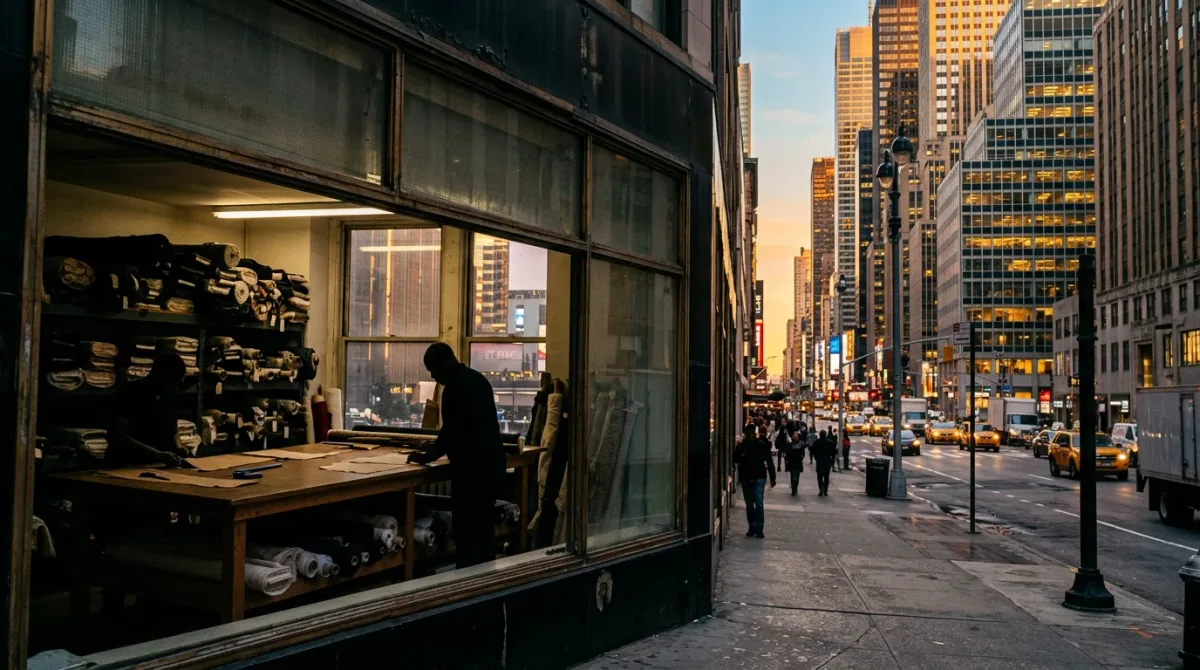
New York still has a Garment District because the city legally forced it to: a 1987 zoning rule, the Special Garment Center District, requires certain buildings roughly between West 35th and West 40th Streets to preserve space for clothing production. That protection has been narrowed twice since — most recently in a rezoning fight that stretched through 2025 — and it now covers a smaller slice of the neighborhood than it did when the rule was written.
What is the Special Garment Center District, exactly?
The district was created in 1987 after the city grew alarmed at how fast manufacturing floors were turning into offices. At the time, according to a New York City Department of City Planning review presentation on the district's history, the area housed roughly 5,000 businesses and 61,000 fashion jobs. The fix was a special zoning overlay layered on top of the neighborhood's ordinary M1-6 manufacturing zoning.
Two sub-areas do the actual work. Along the avenues, M1-6 zoning permits office and manufacturing uses but bars residential development outright. Inside what planners call the P-1 Preservation Area, also zoned M1-6, manufacturing, retail, and showroom or wholesale space — the "protected uses" — are allowed as of right, and converting a building to office use requires permanently preserving production or warehouse space elsewhere in it. A second zone, P-2, sits under C6-4M zoning and allows residential buildings; there, any building larger than 70,000 square feet needs either manufacturing preservation or a City Planning Commission authorization before it can convert to office, hotel, or residential use.
The two-zone split dates to the 2005 Hudson Yards rezoning, which carved the original Preservation Area in half. By 2018, the same city planning presentation found, only 180,000 of the 8.5 million square feet inside the Preservation Areas had been formally set aside for manufacturing — and 67 percent of that already-preserved space wasn't actually being used for manufacturing anymore. Fifty-nine percent of the district's total floor area was, by the city's own count, non-conforming office use squatting inside a zone meant for sewing machines.
Why did the city ease those rules in 2018?
Those numbers were the city's own argument for loosening the rule. On September 26, 2018, the Department of City Planning held a public hearing on a rezoning covering roughly 13 blocks between West 35th and 40th Streets, west of Broadway, according to a hearing summary published by CityLand, the land-use news outlet run by the Center for New York City Law. On October 31, 2018, the City Planning Commission approved it, and the plan moved on to City Council review.
The change eliminated the mandatory preservation requirement for owners of buildings over 70,000 square feet: those owners could convert to office space without setting aside manufacturing floors or getting City Planning sign-off, per CityLand's account of the vote. The rezoning also allowed taller buildings with higher lot coverage and created a special-permit track for new hotel development.
To soften the loss of a hard mandate, the city paired it with incentives rather than requirements: an Industrial Development Agency program offering landlords a dollar of tax benefit per square foot for every 25,000 square feet of manufacturing space they preserved, with participating tenants getting 15-year leases capped at $35 a square foot, plus a $20 million city-backed program, run with nonprofit partners, to buy buildings outright for dedicated garment production. Design Trust for Public Space, the Garment District Alliance, and property owners testified in favor, CityLand reported; Manhattan Community Boards 4 and 5 passed resolutions against it, and then–Borough President Gale Brewer pushed for stronger conditions before the space disappeared for good.
What's different about the fight happening in 2025?
The newer fight is bigger than the district itself. The Midtown South Mixed-Use rezoning, reviewed by the City Planning Commission through the spring and summer of 2025, proposed opening a much wider swath of Manhattan — running roughly from West 23rd to West 40th Streets, Fifth to Eighth Avenues, taking in part of the Garment District — to residential construction for the first time. The city's own environmental review, cited in the Council of Fashion Designers of America's written testimony on the plan, estimated that about 770 businesses and a little over 5,000 jobs could be displaced, including 114 fashion and manufacturing businesses specifically.
CFDA's numbers, drawn from its own count in that testimony, put the stakes for the wider industry at more than 180,000 fashion jobs across the city and over $11 billion in annual wages — a figure CFDA chief executive Steven Kolb repeated at a rally of roughly 150 people in the district on June 18, 2025, as reported by WWD. "This plan is bad because it pays off developers to evict commercial tenants," former City Planning director Joe Rose said at the same rally, per WWD's coverage. Costume designer Deirdra Govan, also quoted there, called the district one of the only places in the country where a designer can "source, pleat, stitch and deliver a garment in 24 to 48 hours." CFDA submitted written testimony to the City Planning Commission on May 5, 2025, and delivered live testimony on July 2, 2025; as of that testimony, the plan was still awaiting City Council review, a timeline CFDA's own account notes is subject to change as the process moves forward.
So is the Garment District disappearing?
Not all at once, and not by accident either. What's happened since 1987 is less a single collapse than a series of negotiated retreats: a hard mandate loosened into tax incentives in 2018, then a much larger residential rezoning proposal testing how much of the remaining footprint the city is willing to trade for housing. Walk the blocks around Seventh Avenue in the high 30s today and the protected uses the 1987 rule was built around — showrooms, cutting rooms, trim houses — still operate, but as tenants inside a zoning map that keeps shrinking around them rather than a district defined by them.
That's the whole trick of a preservation zone: it doesn't stop change, it just makes the city negotiate the terms. The next round of that negotiation is still working its way through City Council, and the built environment on those 13-odd blocks — whatever it becomes — will be the record of how it came out.
For a related fashion perspective, read How New York's New Local Production Fund Actually Pays Garment Makers.
For more context, read Why does SoHo's storefront mix keep turning over?.