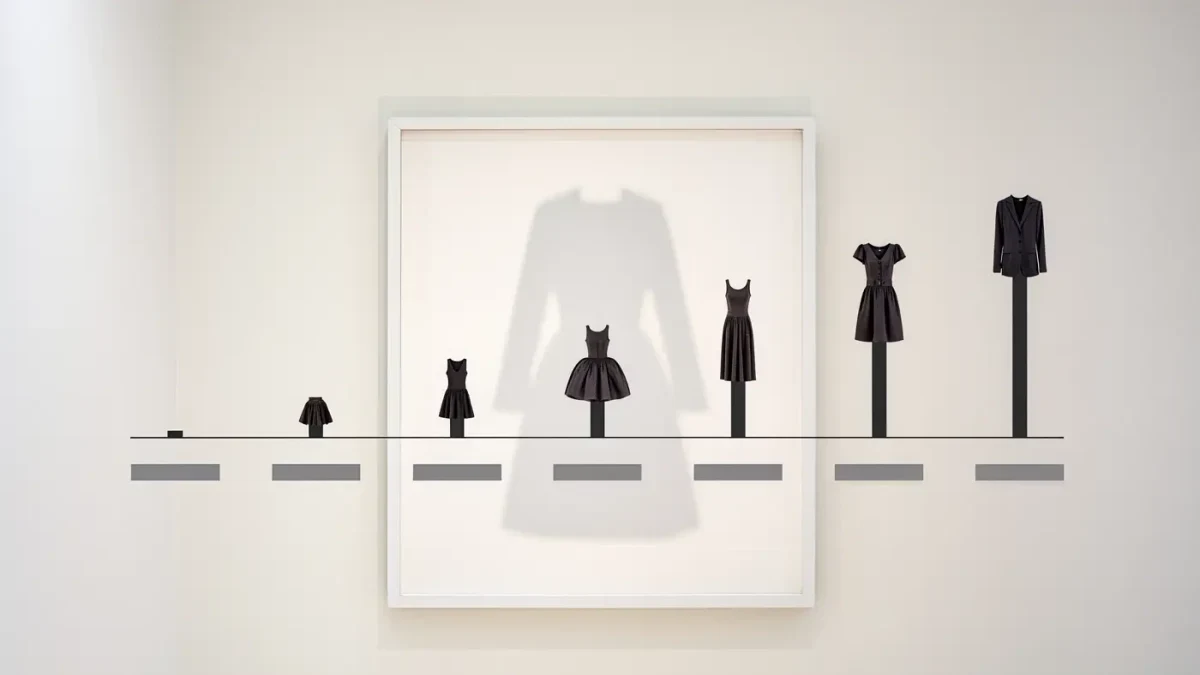
Who decides which clothes from New York's past survive, and which dissolve into the secondhand stream? In this city, two institutions effectively hold the pen: the Costume Institute at the Metropolitan Museum of Art, whose holdings run to roughly 33,000 objects, and the Museum at FIT on Seventh Avenue at 27th Street, whose permanent collection exceeds 50,000 garments and accessories. Everything else — street photography, magazines, retail records — is testimony. These two collections are the evidence. Between them they form the city's working memory of what it dressed in, decade by decade.
The arrangement is older than most people assume. The Met's costume holdings trace to the Museum of Costume Art, founded in 1937, which folded into the Met after World War II; in 2009 the Brooklyn Museum's historic costume collection — one of the oldest in the country — was transferred to the Met, consolidating the borough's memory uptown. FIT built its collection alongside the college itself, on the Seventh Avenue campus at the garment industry's front door, and it functions as both museum and teaching archive for students studying a few blocks from where many of the garments were cut. One institution faces Central Park; the other faces the fashion district. The geography is the mission statement.
Why can't you just walk in and see the archives?
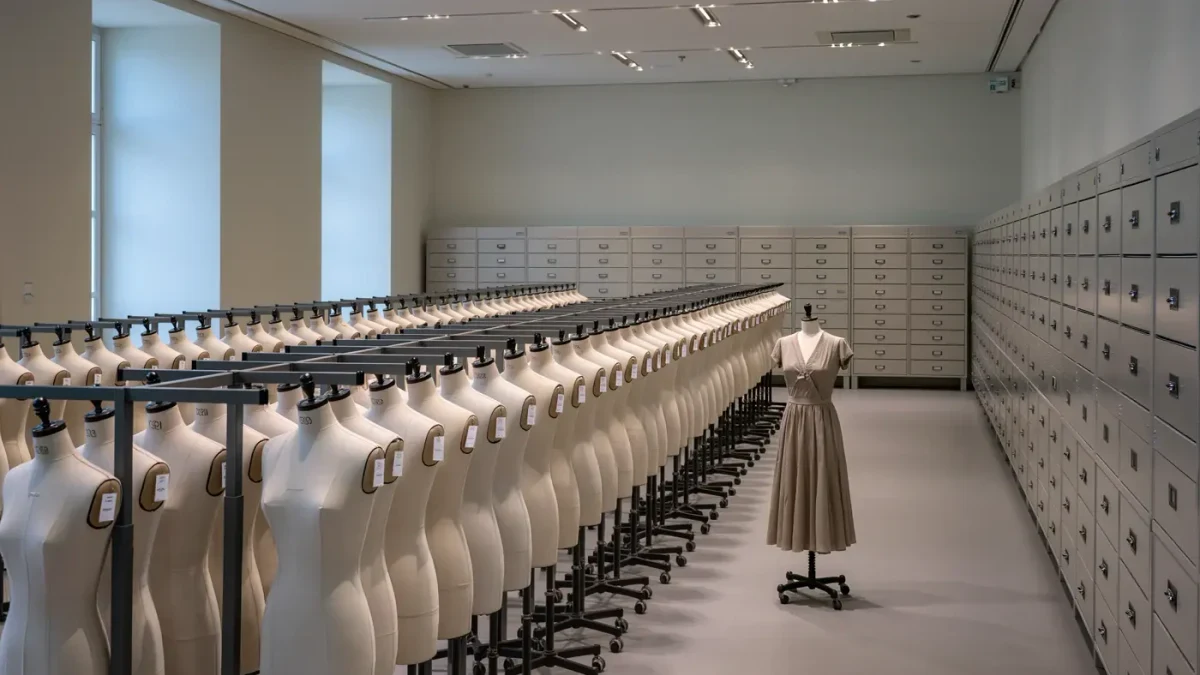
Because light is the enemy and exhibitions are the exception. Textile dyes fade under gallery illumination, and fabrics stress under their own weight, so most of both collections sits in climate-controlled storage at nearly all times, and shows are built as tightly scheduled rotations. A dress may be exhibited for a few months and then rest for years. This is why the Costume Institute stages one large thematic exhibition each spring and why the Museum at FIT runs a cadence of focused, scholar-driven shows: the visible exhibition is a keyhole, not the house. The archive operates on a decelerated clock entirely foreign to fashion's own calendar.
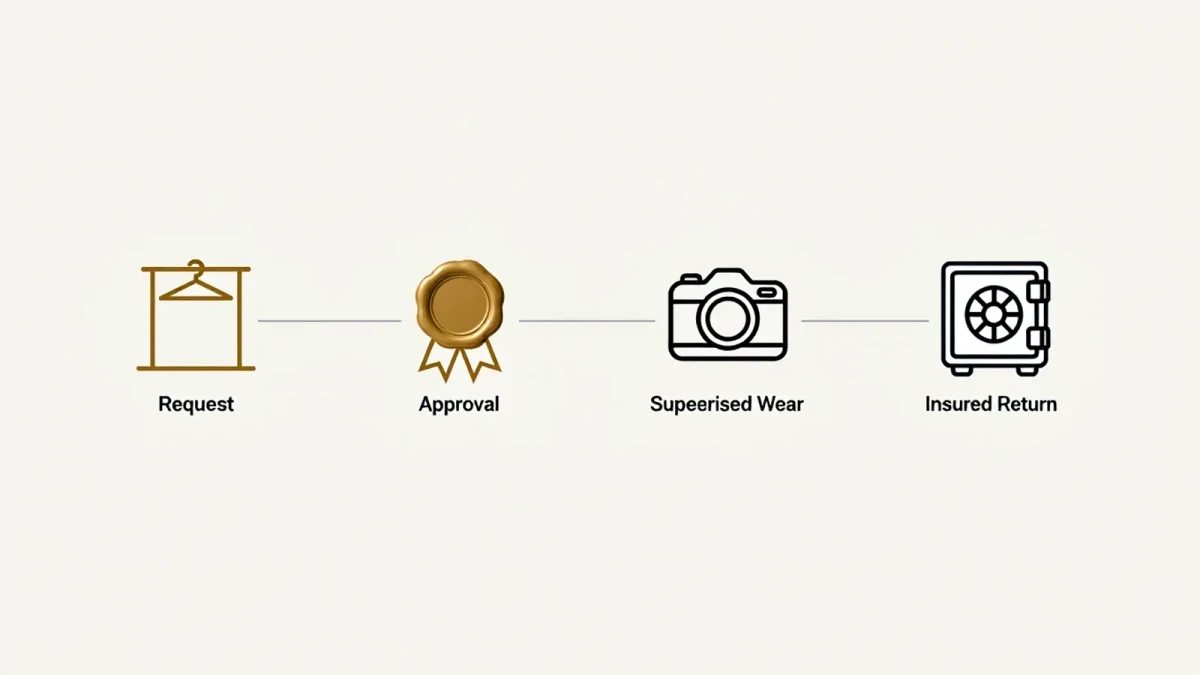
Access follows function. FIT's study collections are actively used by its own students and by researchers who make appointments; the Met's conservators and curators field loans to institutions worldwide and conduct their own scholarship. In both cases the garment is treated as a document — read for construction, fiber, wear patterns, alterations. A hem that was let down tells you about rationing. A bodice resewn twice tells you the dress mattered enough to rework. The archive does not just store fashion; it forensically reconstructs decisions.
What does a New York archive hold that Paris or London does not?
The city itself. A New York costume archive concentrates the local industry: American ready-to-wear, the output of Seventh Avenue houses, sportswear pioneers like Claire McCardell and Bonnie Cashin, the work of Halston and Diane von Furstenberg, downtown experimenters, and the immigrant craftsmanship that built the city's production base — Jewish, Italian, later Chinese and Dominican workshops whose output survives mainly in garments with no surviving maker's name. European archives can tell the story of couture's apex. New York's archives tell the story of what clothing did when it had to work for a living — worn on subways, altered for jobs, bought at department stores whose own archives, notably, have often fared far worse.
That last point deserves weight. The commercial city is terrible at keeping its own memory: department stores dissolve, showrooms clear out, and a house's papers end up in a dumpster on West 38th Street within a week of a liquidation. Museums are the failure-proofing. What no individual wardrobe or company could preserve across a century, two nonprofit collections have — quietly, on 27th Street and Fifth Avenue, in buildings where the temperature is held constant and the lights stay low. New York forgets fast. These two rooms are where it doesn't.
Who actually works in a fashion archive?
A staff whose job titles almost never appear on a fashion-week guest list: registrars, conservators, collection managers, curators with doctorates. A conservator at either institution might spend a week supporting a single 1880s bodice on a custom form, or stitching a support layer into a beaded flapper dress whose silk has shattered — a condition called shattering that silk weighted with metallic salts suffers irreversibly. The work is closer to rare-books conservation than to styling. It is slow, proprietary, unglamorous, and it runs on the conviction that a garment is worth the same custody a library gives a manuscript. The city's fashion mythology is built on speed; its actual memory is kept by people working at the opposite tempo.
Why the archive matters to what you wear now
Every contemporary designer who references a 1940s shoulder line or an exact shade of 1970s jersey is, knowingly or not, borrowing from these holdings — through exhibitions, through published catalogs, through graduate research appointments. The archive is upstream of the trend cycle even though it never appears in it. And for the city's sense of itself, the function is larger: style memory is civic memory. The clothes in these collections record who came here, what work they did, what they could afford and what they aspired to. Fashion's histories are usually told through images. In New York, fortunately, they were also kept in objects — cataloged by accession number, conserved behind muslin, and waiting in the dark for their few months in the light.
Plan a visit accordingly: the exhibitions rotate, the catalogs stay in print, and the archive itself — the real one — is always open to someone with a research question and an appointment.