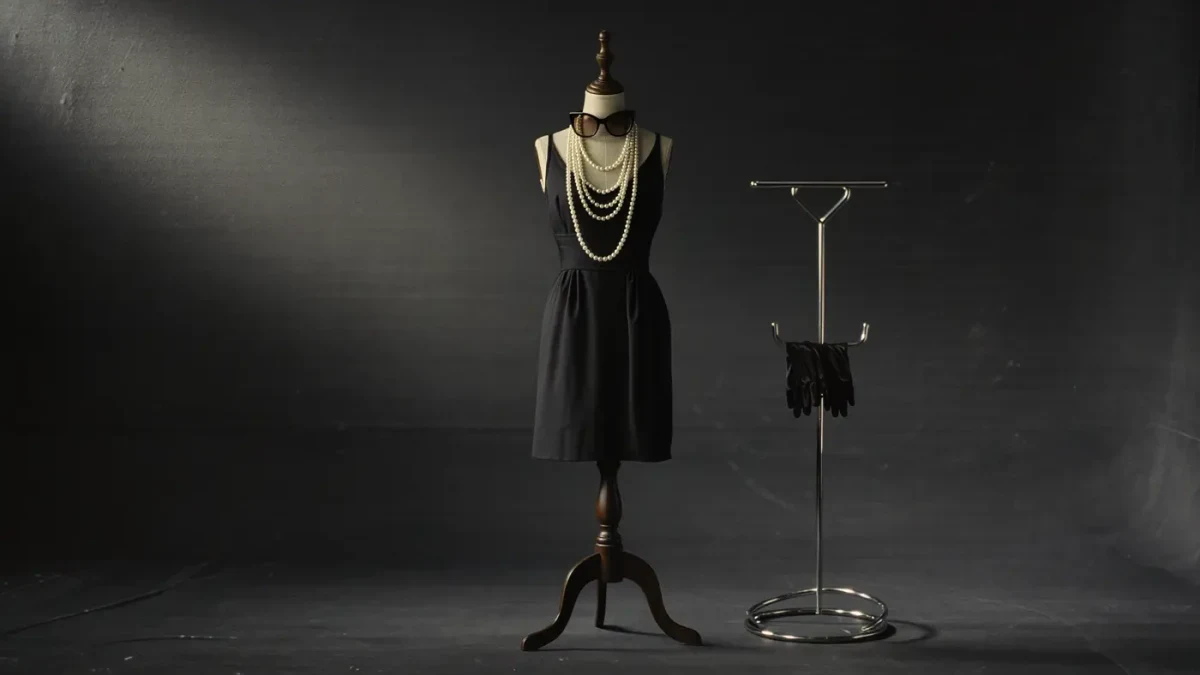
Whose New York does the world actually picture when it pictures New York style? Not the city's. The global idea of how this city dresses was assembled almost entirely on soundstages and location shoots by Hollywood costume departments — Holly Golightly's black sheath and pearls in Breakfast at Tiffany's, Diane Keaton's oversized menswear in Annie Hall, Carrie Bradshaw's tutu and Manolos in Sex and the City, the logo-era hierarchy of Gossip Girl. Most of the people who absorb these images have never ridden the F train. For them, the costume department's New York is the only New York there is, and that fictional wardrobe has more influence than anything the actual city wore this decade.
The mechanism has been running since the medium learned to dress a city. In 1961, Breakfast at Tiffany's gave the world a Manhattan of Fifth Avenue mornings and ascent-by-charm — a New York of the imagination so persuasive that the little black dress became shorthand for urban sophistication on every continent. In 1977, Annie Hall did the inverse: it took a specifically New York androgyne look — vests, ties, wide trousers, a hat that refused to flatter — and made it the most copied wardrobe of the decade, a menswear-inflected style that menswear retailers spent years reconstructing. One film sold the city as elegance; the other sold it as attitude. Between them, the costume departments had written the city's entire style personality for external audiences.
Why does the fiction diverge so far from the real wardrobe?
Because film and television do not dress for weather, commute, or laundry — they dress for narrative legibility at a distance. A real New Yorker's winter is a technical coat problem; a filmed New Yorker's winter is a fur-collared silhouette that reads across a two-second shot. Patricia Field's work on Sex and the City, and later on The Devil Wears Prada, pushed the logic to its apex: outfits as dialogue, each change of clothes a line reading. The clothes communicated character instantly, which is what cameras require and what life does not. Real dressing optimizes for the day. Screen dressing optimizes for the frame.
The economics compound it. Location shoots in Manhattan are expensive and permission-heavy, so productions compress the city into a repertoire of readable locations — the brownstone stoop, the fire escape, the Fifth Avenue window, the subway platform where a character is impossibly well-dressed at 8 a.m. The wardrobe must perform against those backdrops, which is why the on-screen New York wardrobe is theatrical by design. It is not a misrepresentation so much as an amplification: the city's dressiest ten percent, edited to one hundred.
What happens when the costume becomes a real trend?
The 2000s television era industrialized the process. Sex and the City ran for six seasons on HBO and generated two theatrical films, giving its wardrobe four opportunities to be merchandised, copied, and taught; Gossip Girl then codified the class dimension, mapping the city's private-school hierarchy onto handbags and headbands so legibly that the show functioned as a shopping syllabus. Each cycle produced its retail echo within months, and each echo fed the next production's sense of what a New York character should put on. The costume departments were no longer documenting a style. They were minting one, on a broadcast schedule.
The feedback loop closes, and this is the strange part: the fiction keeps dressing the reality it exaggerated. Each generation of the cinematic New York wardrobe re-enters the city through retail — the Annie Hall menswear racks, the Carrie-crafted name necklace, the Return-of-Gossip-Girl headbands of the early 2020s — sold to visitors and residents alike, so that people in New York end up wearing the costume department's idea of New York. Tourists arrive dressed as the city they saw on a screen in another hemisphere; locals, shopping in the same stores, drift toward the same references. The fake wardrobe is no longer fake. It is simply the newest layer of the real one, applied from the outside in.
The Library of Congress's National Film Registry, which has preserved Breakfast at Tiffany's and Annie Hall among its canon of culturally significant American films, treats these movies as national heritage — and the wardrobe decisions inside them have had exactly that kind of permanence. A costume designer working on a Manhattan-set production in 2026 is still quoting choices made in 1961 and 1977, whether or not they intend to. Hollywood built New York a wardrobe the way it built the skyline's postcard version: smaller, brighter, better lit, and placed where the light hits. The city never quite wears it. The world does, permanently.
Can the real city ever take the image back?
Only partially, and the recent record shows how. When street-style photography shifted from runways to sidewalks, and when locals' actual commutes — the practical coats, the sneakers, the deliberate blandness of people carrying garment bags — began circulating globally on their own, the fictional wardrobe finally acquired a rival. But the film version retains structural advantages: it is scripted, lit, and infinitely rewatchable, while the real city has to be visited. For the billions who will know New York only through a screen, the costume department's version is the city. The dress reads before the street does, and Hollywood has always known it.
None of this is a complaint filed on the city's behalf. Costume design is an art with its own histories, and its New York is a genuine cultural achievement — a dream wardrobe, engineered to be remembered in two seconds. But credit should land accurately. The world's idea of this city's style is not an observation of New York. It is a production, shot here or faked here, exported everywhere, and worn back into the city one purchased reference at a time.