Nobody buys anything at a store opening party, and the store would be horrified if they did. The launch is theatre in the strict sense: a scripted evening whose product is not the merchandise but the story that the merchandise now has an address. Brands order the party from producers the way a director orders a set, and the guests — DJs, editors, the neighborhood's attractive regulars — are cast, not courted.
Understand the roles and the whole genre decodes itself. Somewhere in New York, most weeks of the year, a retailer is throwing open a new door with a champagne tray and a sound check, from a sneaker shop on Lafayette Street to a flagship on Madison Avenue, and the script barely changes across price points.
Who actually orders a store opening party?
Usually the brand's retail and communications departments jointly, executed by an events producer and, at the luxury level, the architecture studio that built the space. The retail side wants foot traffic targets and press; the communications side wants images and coverage; the producer wants all of it achieved in a single evening with a load-in window measured in hours. The party is ordered like media, budgeted like media, and evaluated afterward entirely as media.
Budgets vary absurdly. A small sneaker or streetwear launch might run on a five-figure spend — beer from a neighborhood brewery, a friend who DJs, a printed invitation. A flagship opening on Madison Avenue or in SoHo can consume seven figures across lighting design, custom fabrication, catering, security, and talent. Both are buying the same thing: proof that the address now exists in the culture, not just on the lease.
Who gets invited to a store launch?
Four overlapping crowds. The industry list — editors, stylists, buyers — comes from the PR agency. The talent list comes from the brand's casting or celebrity team. The neighborhood list — local business owners, building neighbors, community figures — comes from the retail staff, and it exists because a store lives or dies by its block long after the party ends. And the friends-of-brand list, the people who make the room look right, comes from everyone's contacts app at once.
The mix is the art. Too much industry and the party feels like a lobby; too much talent and the actual customers' world feels excluded; no neighbors and the store inherits a cold relationship with its own street. Veteran producers describe store parties as the hardest room to balance in the event business precisely because the guest list has to serve four masters for one night.
What happens at these parties, actually?
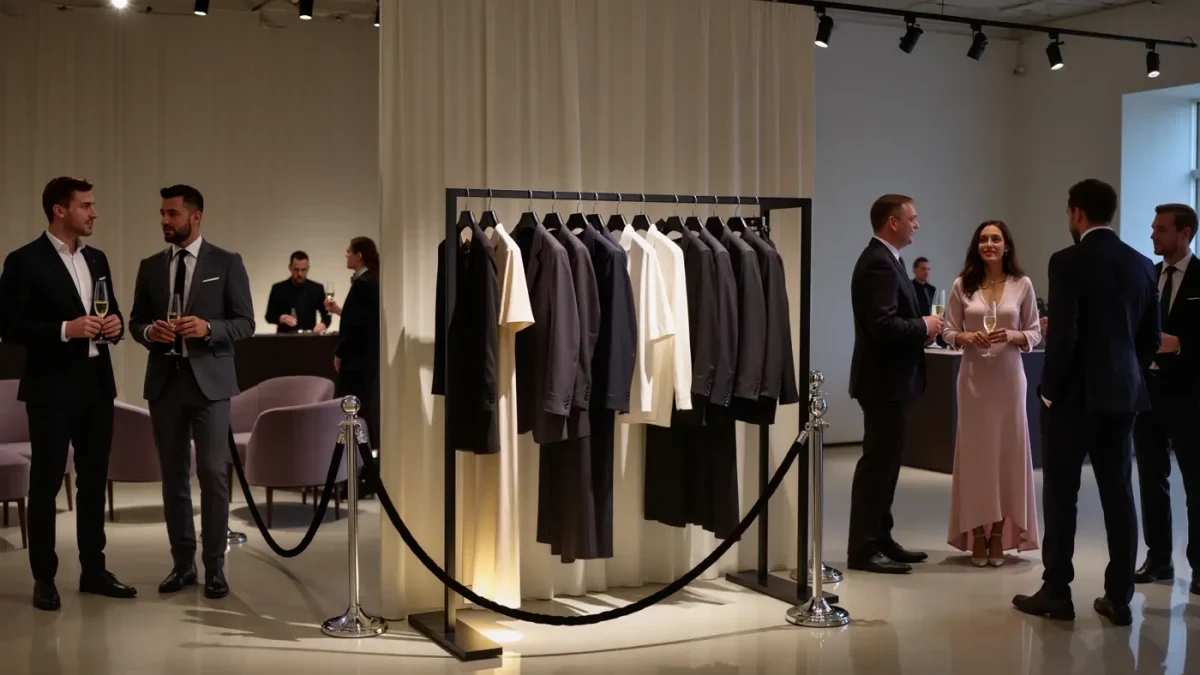
A great deal of not-shopping. The merchandise is present, lit, and usually roped or guarded; purchases are possible and rare. The evening's real activities are circulation and capture — guests moving through the space on a route the design team engineered, cameras documenting the route, and the bar positioned to pull people toward the merchandise the brand most wants photographed. The store's architecture is the stage set, and the traffic pattern is the blocking.
This is why opening parties so often feel sparser than the store will ever be again. The room is built to be photographed at half capacity, with clean sightlines to the fixtures. A packed launch makes bad images; a well-spaced one makes the space look like it lives that way every day, which is the fiction the entire evening exists to produce.
The timing is theatre too. Launches cluster around moments the city is already paying attention — the start of fashion week, an art fair weekend, the first warm Thursday of spring — because borrowed attention is the only kind that scales. Producers hold dates the way theatres hold openings, and a launch that lands on a dead weekend spends its whole budget shouting into an empty street.
Why do brands keep throwing them?
Because the launch party converts a real-estate event into a cultural one, and culture is what drives the first season's traffic. Retail reporting has long noted that a new store's opening months determine its trajectory; the party is the cheapest lever available for making those months loud. Per the announcements brands publish around each launch, the pattern holds from the Lower East Side to the Upper East Side: DJ, drinks, crowd, images, coverage, then a store that wakes up the next morning with a story attached.
The party also functions as a staff ritual. The retail team that will run the store meets the industry that will write about it; the store manager shakes the hands that will send the clients. Theatres call this a curtain-raiser, and the term is exact — the show, which is the store operating daily for the next five years, begins the moment the party ends.
How is success measured after the doors close?
Not in sales, which are understood to be near zero, but in clipping counts, social reach, and the quality of who appeared. A launch is judged successful if the images that circulated feature the right people standing in front of the right fixtures — the store effectively directing its own first press cycle. The internal debrief reads like a campaign post-mortem because that is exactly what it was.
That's the whole trick of retail theatre: the party sells nothing on the night so that the address can sell everything afterward. Everyone came, no one bought, the photographs did the commerce, and by the weekend the store was simply a store — which was the performance all along.