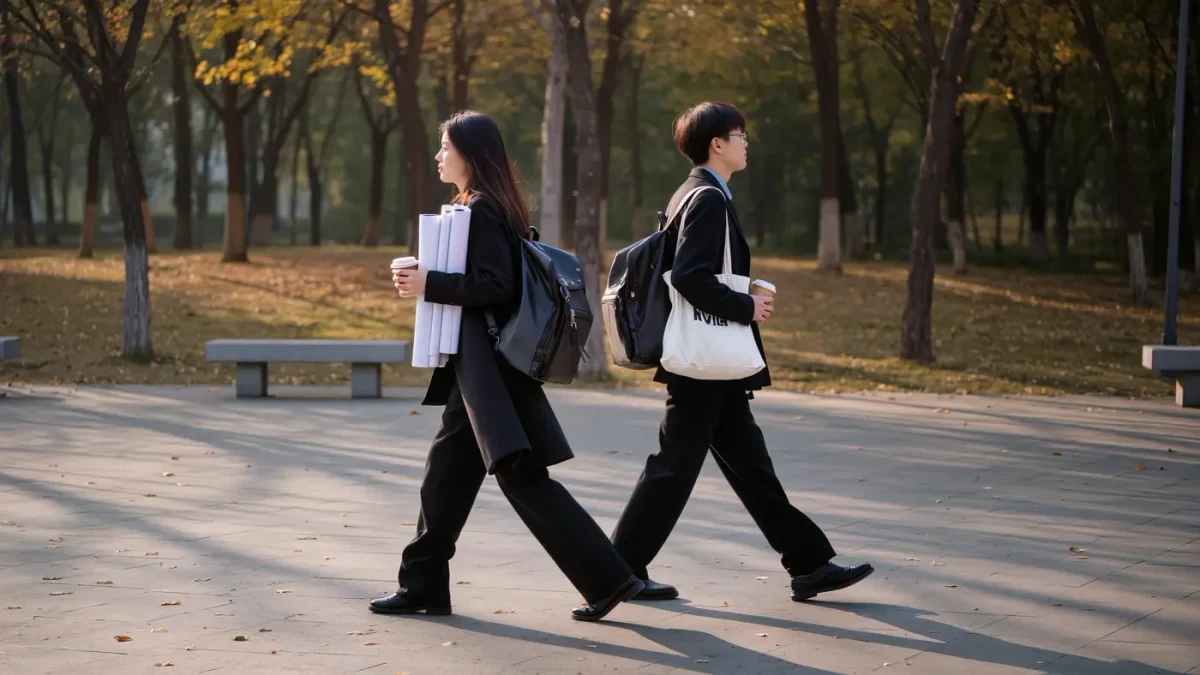
What do students wear when their campus has no campus — when the university is a scatter of buildings folded into a working neighborhood? At NYU, whose classrooms ring Washington Square Park, and at Parsons, whose buildings hold the blocks around Fifth Avenue and Union Square, the answer has changed more in the last fifteen years than in the previous fifty. The Village student wardrobe was once a citywide reference: a genuinely local code of thrift, irony, and art-studio practicality that the rest of the country watched and copied. The blocks now hold hold tens of thousands of students dressed in a wardrobe that is flatter, darker, more expensive, and far more interchangeable. The neighborhood didn't stop producing style. The students stopped producing it locally.
The structural facts explain a lot. NYU's campus is famously distributed — dorms and buildings across the Village and toward Union Square, with Washington Square Park serving as the de facto quad, which means student style is performed on public streets rather than in a protected campus bubble. Parsons sits inside the same ecosystem, one train stop apart, with a mandate that makes its students a visible exception: design students wear what they make, so the look around Fifth Avenue and 13th Street still carries a signature of constructed, experimental pieces no other demographic wears. Between the two schools, the Village holds one of the densest concentrations of young consumers in America, dressed for jobs, internships, and a city that prices out improvisation.
What actually changed from the old Village look?
Three things, roughly in order of importance. First, thrift died as a strategy and became a boutique: the East Village and Village vintage shops that once supplied students at beer money now price for collectors, so the accumulated, idiosyncratic wardrobe that defined the local look got priced out of students' reach. Second, the uniform consolidated — black layers, practical sneakers, one expensive item as flagship — a wardrobe optimized for commuting, internships, and looking employable rather than for expressing a scene. Third, the feed arrived: when everyone's outfit is potentially content, the safest outfit is the one already validated online, and validated outfits converge. The old Village look ran on risk. Risk is now the most expensive ingredient in the wardrobe.
The economics underneath deserve plain language. A student wardrobe in New York is assembled under rent pressure that has no campus-era precedent: clothing budgets shrink exactly as housing costs expand, and the rational allocation is fewer, better, quieter pieces. The result reads as sophistication from a distance and as conformity up close. The Beats and the bohemians who wrote the Village style myth were, among other things, poor in a cheap neighborhood — an economy that made eccentric dress a survival strategy with a soundtrack. The contemporary student is poor in an expensive one, where eccentric dress reads as a luxury good, and everyone knows it.
Is there still a difference between an NYU student and a Parsons student?
Yes, and it is the clearest surviving gradient in the neighborhood. The Parsons orbit still wears evidence: dyed, repaired, self-sewn, visibly worked-on garments that function as both clothing and portfolio, moving between studios on West 13th Street like walking business cards. NYU's population, split among programs from acting at Tisch to finance at Stern, dresses in dialects of seriousness — art students in costume-proof layers, business students in internship-ready neutrals, everyone sharing the sneaker-and-tote infrastructure of a campus measured in subway stops and hourly library shifts. The two schools' styles overlap more than they did, mainly in the shared baseline of black, but the difference between wearing clothes and wearing arguments remains visible on the same block.
Washington Square Park itself still functions as the runway it has always been — the fountain as stage, the benches as front row — but the show's audience changed. What gets noticed in the park now circulates in photographs within hours, which disciplines the wardrobe in advance. Students dress knowing the frame is live, and the pre-emptive self-editing shows. The park remains the best people-watching seat in Manhattan. It simply watches a more cautious production than it once did, staged by students who know the whole city, and increasingly the whole internet, is in the second row.
What did the old Village look actually consist of?
Worth specifying, because the myth blurs it. The mid-century Village wardrobe was thrifted and adapted — work shirts, army surplus, black turtlenecks for warmth in unheated walkups, dancer's practice clothes on Bleecker, boots chosen for pavement miles rather than profile. The look's authority came from legibility: a passerby could read occupation, allegiance, and budget in five seconds, and the details were locally sourced from the blocks' own secondhand shops and army-navy stores. It was, in other words, a poor neighborhood's functional dress that happened to photograph like philosophy. The myth later kept the philosophy and discarded the poverty, which is why nostalgia for it sits so strangely beside the neighborhood's current prices.
Does campus style still matter to the city?
Less as a trend engine, more as a forecast. The Village look of the mid-twentieth century seeded decades of American fashion precisely because it was cheap, local, and visible; none of those three conditions holds the way it did, so the neighborhood's stylistic exports have slowed accordingly. What the campus blocks produce now is subtler — a national preview of how a generation solves dressing under constraints: durability, resale, one good coat, comfort as non-negotiable. That forecast will prove more consequential than the old eccentricity, because it is being worn by the demographic that will soon be dressing everyone else. The Village myth says students here dress like the future. They still do. The future just looks more practical than the myth promised.