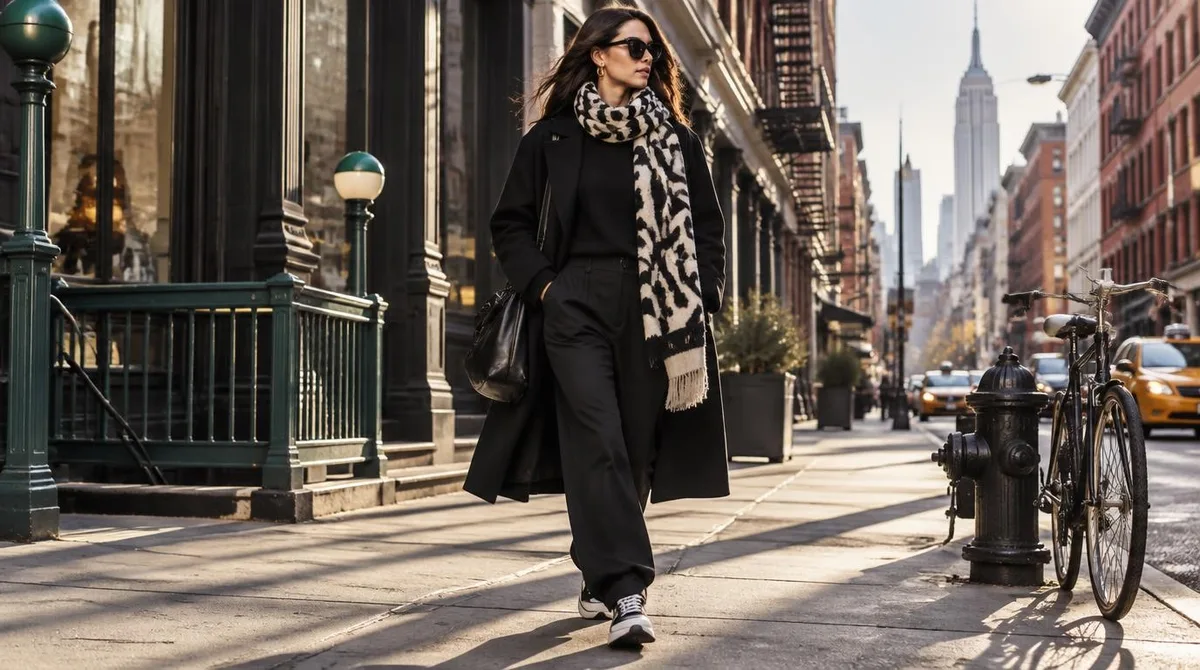
NYC street style right now is less a single look than a set of habits: black as a base color, sneakers chosen for the mileage, and one loud item doing all the talking while everything else stays quiet. That is the honest answer. The city does not dress in one trend the way a runway season does, because the city is not one audience.
The scale explains some of it. New York is the most populous city in the United States, with roughly 8.8 million people packed onto about 300 square miles of land, according to Wikipedia's New York City entry. Density like that means a SoHo sidewalk and a Bronx bus stop are running different fashion weeks on the same afternoon. What ties them together is not a silhouette. It is a set of practical rules the whole city seems to have agreed on without a meeting.
Those rules are worth spelling out, because they are the closest thing New York has to a current style definition. Here is what they look like, and where each one comes from.
Why does New York dress in black?
Because black solves every problem this city throws at a wardrobe at once. It hides subway smudges, reads as dressed-up or dressed-down depending on the fabric, photographs well against gray pavement, and lets a person move between a gallery and a bar without changing. The color is the city's default not because it is chic but because it is efficient. Our field guide to the city's uniform color goes deeper on the history; the short version is that black is the only color that never argues with anything. For related coverage, see Why New York Wears Black: A Field Guide to the City's Uniform Color.
The current twist is texture doing the work that color usually does. When everything is black, the interest moves to surface: a matte knit against a shiny leather skirt, a washed-out cotton against a crisp wool coat. Watch a well-dressed New Yorker and you will often see five black garments that are each a different material. That is the whole trick.
What does the commute decide?
Almost everything below the knee. New Yorkers walk more than people in most American cities, and the walk is not optional — it is the last six blocks of every trip. So the defining shoe of NYC street style is a sneaker, worn with tailoring, with dresses, with everything. The city's shoes are a logistics decision first and a style decision second, which is the argument our look at what New York's shoes say about the city makes in detail.
The same logic runs through outerwear. The coat is the garment everyone actually sees for half the year, so it carries the outfit. A statement lives on the outside layer; whatever is underneath just has to work. This is why a plain outfit can read as deliberate here — the coat is doing the presentation, and the person knows it.
Is there really an uptown-downtown split?
Yes, but it is softer than the old stereotype. The classic version — polished and put-together above 96th Street, thrifted and experimental below Houston — still shows up in who wears what, but the borders blur more than they used to. Secondhand shopping has moved from a downtown subculture to primary retail in whole neighborhoods, a shift our reporting on the East Village's secondhand scene traces block by block. Meanwhile, work dress codes have loosened enough that the Financial District now tolerates sneakers and soft trousers where stiff suits once ruled. We covered a connected angle in Rainy Day Outfit — Rain-Proof Dressing: What to Wear in a New York Downpour When You Still Have to Look Put Together.
The useful way to read the split today is not geography but context. The same person might wear head-to-toe vintage on a Saturday in the East Village and a clean dark uniform on a Tuesday in Midtown. NYC street style is wardrobe management, not a fixed identity. Our piece on the uptown-downtown style split follows that tension through both halves of Manhattan.
Where does the confidence come from?
Partly from the city itself. New York's official tourism campaign leans on the idea openly: the city is described as loud, intense and nonstop, with "bold looks and a city made for making an entrance" listed under what it calls Main Character Energy, per NYC Tourism + Conventions' The NYC Effect campaign. Marketing copy, yes. But it names something real about how people dress here — the willingness to be looked at, to wear the loud coat on a Tuesday, to treat the sidewalk as a place where being seen is the point rather than the risk.
The other part is necessity. A dense city puts every kind of dresser on the same sidewalk, and style ideas travel fast when the distance between inspiration and imitation is one subway stop. Our piece on subway lines and style tribes looks at whether the map really is a style map; the honest finding is that influence moves along it, even if no single line owns a look.
What this means for your own wardrobe
Our analysis of how New Yorkers actually dress comes down to three principles that outlast any season. First, build on a quiet base — black, or whatever your version of it is — so one strong piece can carry the outfit. Second, buy for the walk: if the shoes cannot survive six blocks, the outfit is decoration. Third, let fit do the flattering. New York style looks effortless mostly because the clothes are the right size, which is a skill anyone can learn, not a body type anyone is born with.
The budget point matters too. Much of what reads as current on the street is secondhand, tailored down to size, and worn hard. The city's tailors and alteration shops are the quiet infrastructure behind a lot of "effortless" — a hidden economy our report on tailors and dry cleaners documents. A ten-dollar hem can make a thrifted trouser look intentional. That math beats a new full-price coat every time.
What the evidence establishes is this: NYC street style today is practical at the base and expressive at the edges, held together by black, sneakers, outerwear and confidence rather than any single trend. What remains unknown is the next shift — whether the loosened office code keeps drifting casual or swings back, and which neighborhood supplies the next idea. The city will decide by walking.