What happened to the Wall Street suit? It did not die; it got optional, which turned out to be a different fate entirely. When a dress code is mandatory, it is a uniform and nobody thinks about it. When everything is allowed, getting dressed becomes a daily negotiation with ambiguity — and the financial district, the most dress-coded square mile in America for a hundred years, is now the most interesting place in New York to watch that negotiation play out.
The timeline matters. Formal business dress eroded in finance in slow waves: business casual in the late 1990s tech-adjacent sectors, casual Fridays in the 2000s, then the full rupture when remote work in 2020 emptied the towers and, in many firms, nobody was left to enforce anything. By the time offices refilled, most banks and asset managers had quietly moved to vaguely worded 'client-ready' standards — dress for your calendar, not your desk. The phrase is doing enormous work.
What does 'client-ready' actually mean in practice?
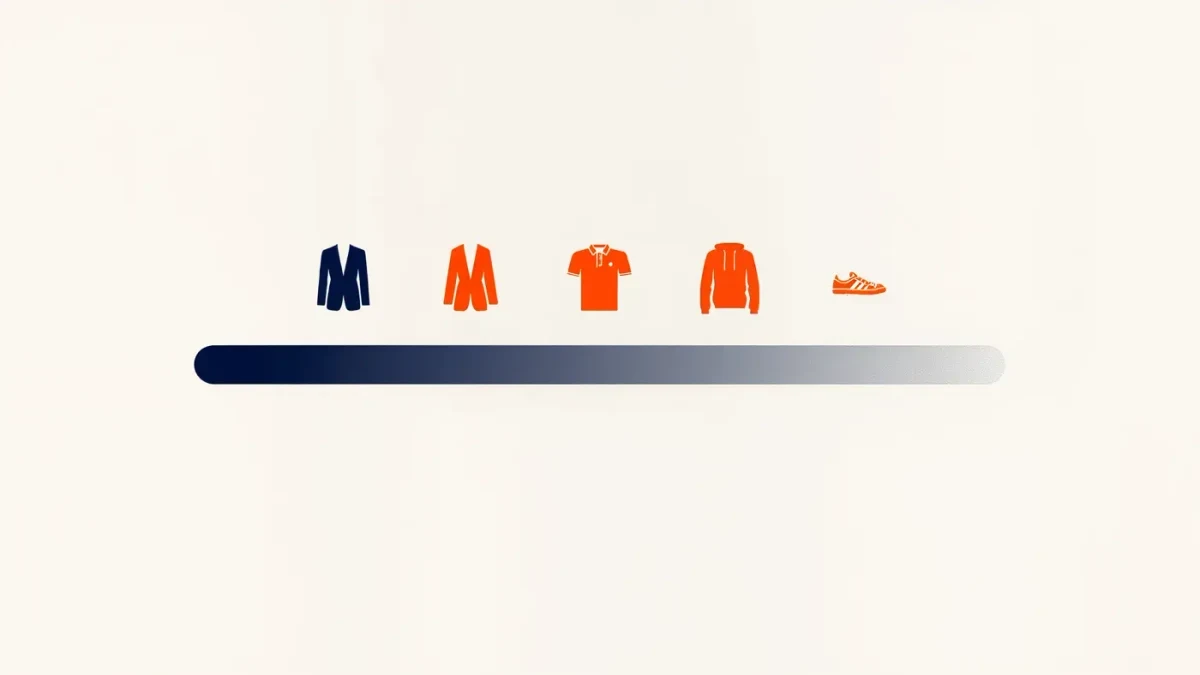
It means a wardrobe built around a forecast of who you might see. A trader who never leaves the floor can wear what amounts to athletic wear; the same person keeps a jacket at the office for a surprise client meeting. Relationship bankers and anyone in investor relations dress close to the old way but with softer construction — unstructured blazers, knit polos under jacket, premium sneakers that photograph as leather from six feet. The old binary of suiting versus casual has been replaced by a gradient, and everyone calibrates daily against an internal chart of meetings, clients, and seniority in the room.
The result, on a lunchtime walk through the food halls around Water Street or the lines outside salad counters on Pearl, is a street scene no fashion forecaster would have drawn in 2015: technical trousers with loafers, quarter-zips with tailored coats, full suits — still, sometimes, worn by choice or by seniority — moving through a crowd dressed for a weekend. Nobody looks wrong. That is the strange part. The code did not collapse into chaos; it dissolved into interpretation.
Who kept the suit, and why?
Seniority and client exposure are the two great retainers. Managing directors meeting sovereign wealth funds still wear tailoring because the audience for those meetings expects it — dress, at that altitude, is a courtesy extended across cultures. Younger employees in back-office and technology roles have often never owned a suit. Between those poles sits the mid-career calculation: dressing up too much reads as trying, dressing down too far reads as slippage, and the safe zone keeps shifting. Career advisors and executive coaches, along with workplace surveys covered periodically by Bloomberg in its employment coverage, note that ambiguity falls hardest on exactly the employees with the least seniority to absorb the risk.
Gender re-prices the ambiguity further. Women in finance historically faced stricter scrutiny of dress than male colleagues, and a collapsed code cuts both ways — fewer formal rules to violate, but also fewer clear rules to hide behind. The professional uniform that once said 'I belong here' now has to be assembled fresh each morning, which is its own kind of unpaid labor.
What replaced the suit economically?
A wardrobe of hybrid garments, and a retail shift to match. The soft trouser, the knit blazer, the leather sneaker in conservative colors, the overshirt: the whole category exists because finance and professional offices stopped requiring tailoring but never stopped requiring the appearance of seriousness. Sales figures reported by the U.S. Census Bureau's retail monitoring show casual and hybrid apparel outperforming formalwear for years running, and the landlords of FiDi have noticed — storefronts that sold suits a generation ago now sell $140 sweatshirts to people who work above them.
Something was lost and something was gained, and it is worth being honest about both. Lost: the democracy of the uniform, which made a junior analyst and a CEO visually identical and let clothing stop being a daily referendum. Gained: comfort, individuality, and the end of a dry-cleaning bill that functioned as a private tax on ambition. The towers on the south end of Manhattan dressed as one century-long monochrome experiment in conformity, and the experiment ended not with a memo but with an absence — nobody ever announced that the suit was over. Everyone just stopped being sure it was on.
What should a new hire wear in the meantime?
The durable advice is to mirror, then drift. Spend the first weeks dressing at the median of your immediate team — not the most formal person, not the least — then adjust in single steps as you learn which meetings carry dress consequences. Keep one full professional outfit at the office as insurance; the surprise client call has not been abolished, only made unpredictable. And budget for the hybrid wardrobe's hidden cost: its garments work harder and wear faster than either pure category did. The old suit lasted because it was worn gently on select days. The knit blazer earns its keep daily, and the price tags on everything reflect that arithmetic whether the wearer has noticed yet or not.
The dry cleaner felt the collapse before the suit maker did, for the simple reason that pressing revenue is weekly while suiting purchases are episodic. The wash-and-fold counters that now anchor many FiDi-adjacent storefronts are, in a literal sense, the dress code's replacement economy: where pressed shirts once subsidized the shop, laundry volume does. Wall Street's wardrobe downgrade registered first not on any runway or in any boardroom memo but in the service economy that had quietly billed itself against formality for a century — hemmers, pressers, shirt laundries — some of which never found a replacement product at all.