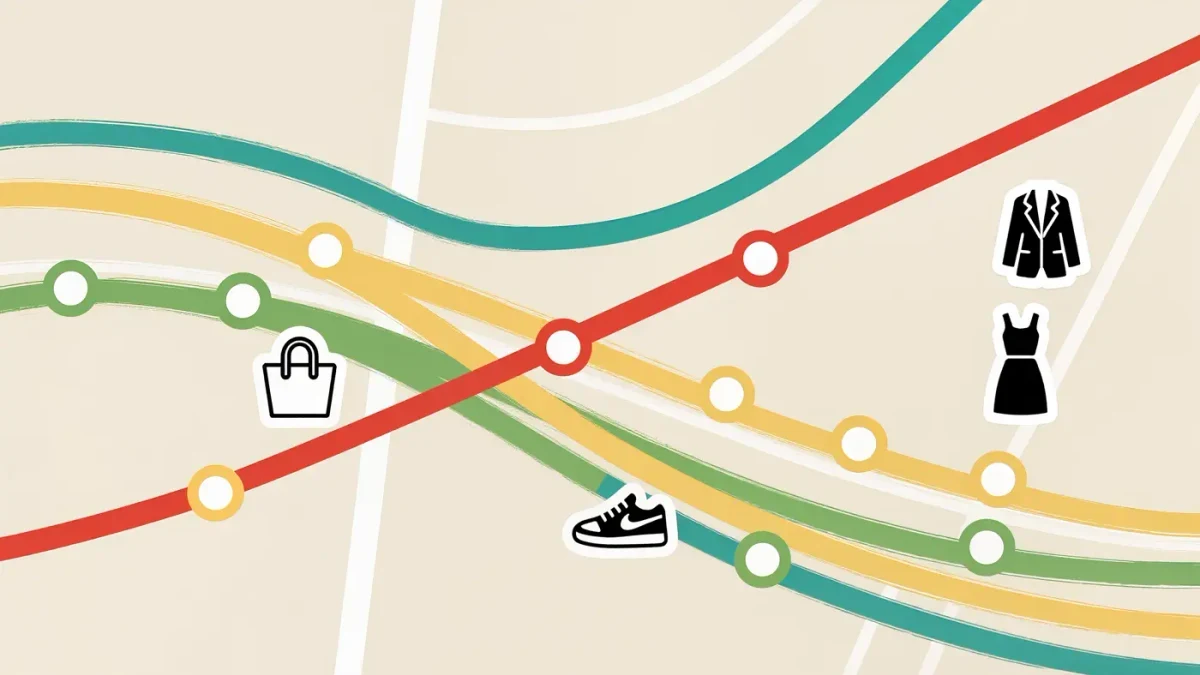
Do different subway lines really have different styles? Yes — but not the way the folklore tells it. Each line carries a genuine cross-section of its neighborhoods, and since New York's neighborhoods remain economically and culturally distinct, the trains inherit the distinction. The style tribe is real; the causality runs through rent, not fashion. A line is a style corridor the way a zip code is: an aggregation of commutes, not a club anyone joined.
Start with the folklore, which every New Yorker can recite. The L is fashion and tech, all sensible tote bags and monochrome. The G is scrappy, queer, artistic, allergic to polish. The 2/3 through Harlem and the Upper West Side dresses with Sunday-formality on ordinary Tuesdays. The 7 takes you from the fashion-adjacent abundance of Long Island City through courtrooms and Queens' working-immigrant corridors. The J/M is the new frontier of priced-out artists. None of this is science. All of it contains data.
What is actually true in the stereotype?
The true part is demographic sequencing. A subway line is a fixed sample of the census tracts it threads, and census data from the U.S. Census Bureau shows how sharply income, age and occupation shift between adjacent tracts in New York — often within a mile. The L between Bedford and First Avenue samples a neighborhood that changed economics twice in twenty years; the A through the Rockaways samples something else entirely. Riders board dressed for their day, so the train aggregates those days. You are not seeing a tribe. You are seeing a labor market on wheels.
Time of day matters more than line, and this is the part the folklore skips. The 8 a.m. L and the 11 p.m. L carry the same geography but different populations — commuters versus service workers heading home, versus the nightlife economy heading out — and the perceived 'style' of the line flips accordingly. Ride any line at three shift changes and the tribe dissolves into schedules.
Which lines have the strongest style reputations?
The L remains the heavy favorite, less for what it is than for what it became: the train of the Williamsburg migration, therefore the default shorthand for a specific uniform of black layers, canvas totes and quiet sneakers. The G's reputation is recent and reputationally volatile — as Brooklyn rents redistributed its population, the scrappy car became harder to distinguish from any other. The 2/3's formality is a real and widely admired tradition, rooted in churches, professional life and a culture of dressing that predates every current fashion cycle. The 7 is the city's most honest line, if honesty means range: it carries more of the actual economy of New York on any given afternoon than any other train, and its platform crowds at Flushing–Main Street or Jackson Heights read like a textile import ledger come to life.
The money lines have reputations too, mostly unearned. The 4/5/6 through the financial district and the Upper East Side carries every class of worker into the same towers; its style mix is professional at the top stations and entirely ordinary everywhere else. The myth of the 'suit train' dissolves by 96th Street.
Why does the myth persist if it is soft?
Because it is useful. New York is too large and too anonymous to read at street level, so residents use any available shorthand, and trains are the city's most repeated social samples. The commuting statistics published by the Metropolitan Transportation Authority and reported through federal transit data show daily ridership in the multiple millions — an enormous number of repeated observations, each one confirming a bias or complicating it. Style tribes are how New Yorkers compress all that data into something a person can navigate by. The stereotype is a heuristic, not a census.
There is also the feedback loop of self-presentation. People who know a line's reputation sometimes dress to it, or against it, which manufactures a little more truth every year. Folklore that changes how people dress eventually becomes partially accurate — a phenomenon the city has run on for a century.
The final verdict, then: the subway is a real style map the way a river is a real border — drawn by geography, policed by nobody, believed by everyone. Ride the line of any neighborhood and you will meet its commute, which is close to meeting its character. Just ride it twice, at two different hours, before you call it a tribe. The second ride is the research.
Can you actually use the folklore to navigate?
Cautiously, and mostly in reverse. The tribes tell you less about who you will meet than about who assumes they will — the map is a document of perception, which is its own useful instrument. A newcomer can calibrate expectations for a neighborhood by how its line is described, then verify on foot, and the gap between folklore and platform is often the most interesting data of all. Williamsburg's L and Bushwick's L share a letter and not much else at this point. Treat every car-by-car prediction as a hypothesis with a schedule attached, and the subway becomes what it has always been for careful observers: the most efficient style survey in the city, conducted at the price of a fare.
Holiday and event nights offer the cleanest experiments. The night of a major downtown parade, a championship, or the first warm Friday of spring, lines that 'belong' to one aesthetic visibly fill with the whole city, and the folklore breaks in real time — formal wear on the L, beach gear on the 2, everyone dressed for the same destination. Those nights function as a control group. They show what the daily pattern already implied: the tribe was never on the train. It was in the boarding pattern all along, dispersing every few hours and reforming with the next shift, dressed each time for wherever the city was sending them.