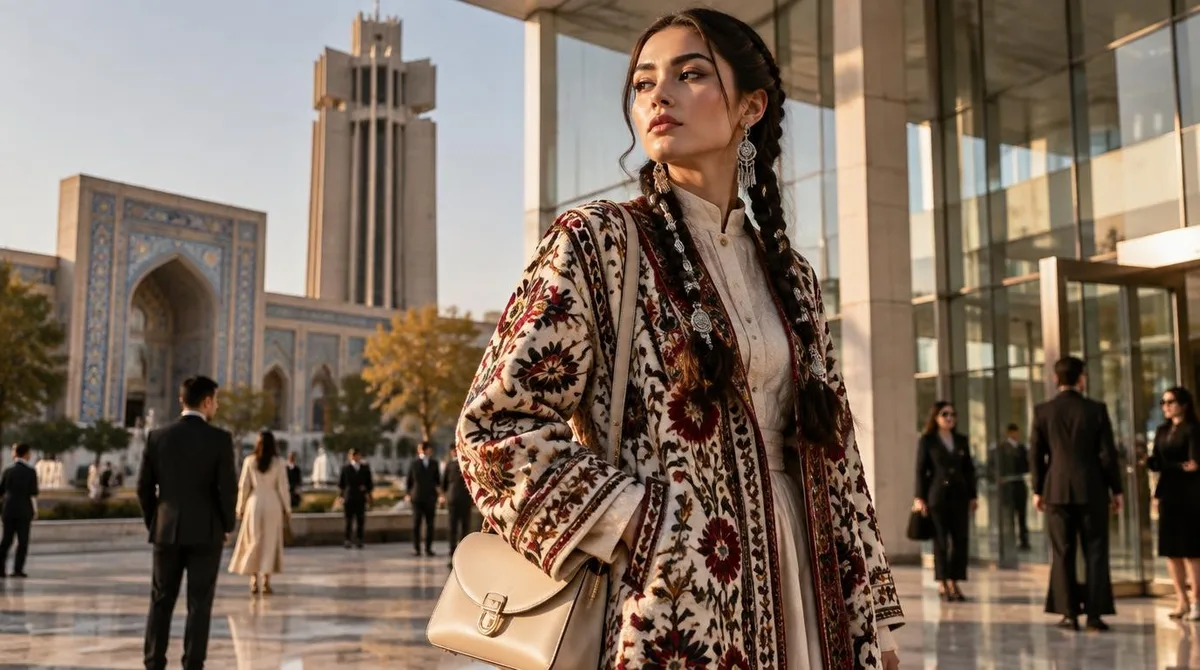
The best street style looks from Fashion Week Tashkent put a modern spin on tradition, and that framing matters more than it first appears. Per Vogue Adria, the streets outside Visa Fashion Week Tashkent are full of traditional patterns, richly embroidered clothing, long braids threaded with ornaments, ornate jewelry and hats inspired by historical headwear — all worn alongside contemporary cuts, Western designer bags and statement shoes. That mix is not a novelty act. It is a working answer to a problem every fashion capital now shares.
The problem, as the Vogue Adria reporting puts it, is that street style photography has become city-blind. It has become almost impossible to tell from a street style photograph which city it was taken in, the piece argues, because most cities are slowly losing their fashion identities while chasing the same algorithm-approved aesthetic. Tashkent reads as the counter-case: tradition treated not as costume or a composed postcard of local culture, but as a natural starting point for personal style. We covered a connected angle in Michael Kors Puts 'New York Chic' Back at the Center of Fashion Week.
For anyone following how cities dress — New York included — that is the real story here. The culture of street style has spent a decade rewarding legibility: the same silhouettes, the same bags, the same styling tricks, optimized for the same feeds. Tashkent's scene suggests a different reward structure, one where the recognizable local detail is the point rather than the liability.
Why has street style started looking the same everywhere?
Because the incentive is to be legible to a global audience, not to a local one. When the photograph's destination is a feed rather than a neighborhood, the safe move is the look that reads instantly anywhere — and that is how, per the Vogue Adria piece, most cities end up fitting the same aesthetic template. The reporting describes this as an almost complete loss of fashion identity in street style photography, a claim about visual sameness rather than a measured statistic, but the diagnosis is specific: sameness is a product of where the image is headed.
Tashkent inverts that. The traditional elements there — embroidery, ornamented braids, historical headwear, ornate jewelry — are described as adapting to the way people dress today without losing what makes them recognizable. Pairing them with modern silhouettes and unexpected details, the piece argues, gives them a new dimension while each person's style still reads as individual.
What does 'tradition without costume' actually mean?
It means the folk elements are worn the way a leather jacket is worn anywhere else: without agonizing over what can be paired with what. That is the detail in the Vogue Adria reporting worth sitting with. The traditional aesthetic in Tashkent is not staged for visitors and not confined to the past. It mingles freely with contemporary influences, and the creativity people bring to dressing gives the street style its variety and personality. There is little agonizing over combinations; people play with contrasts and unexpected pairings that make every outfit a little different.
The distinction is easy to state and hard to pull off. A costume reads as a performance of identity for an outsider's benefit. What the Tashkent scene shows, per the reporting, is identity worn for its own sake — traditional details sitting as naturally next to a Western designer bag as they do next to each other.
Who is actually wearing this, and how differently?
Different generations, different sensibilities, and influences from across the region — that is the range the piece documents during Fashion Week. Some guests gravitate toward rich embroidery, striking embellishments and accessories that reflect their cultural heritage. Others take a subtler approach, pairing understated details and familiar patterns with contemporary pieces in ways that feel entirely their own.
What they share, per the reporting, is a sense of identity they have no intention of giving up just to look like the crowd in any other fashion capital. That is a pointed line, and it lands because the two approaches — maximal and subtle — both count. There is no single correct way to wear the local tradition, which is precisely what keeps the scene from becoming a uniform of its own.
What should fashion capitals, including New York, take from this?
Take the mechanism, not the mood board. The lesson from Tashkent is not 'add embroidery' — it is that a street scene gets interesting when people have a local starting point they feel free to remix. New York has its own version of this question, and it is usually argued through runway programming and retail rather than street dressing. The city's fashion identity debates tend to live in institutional choices — who shows, what gets stocked, which neighborhood anchors the season — more on that in Who Really Decides When a Designer Shows at Fashion Week? For related coverage, see Who Really Decides When a Designer Shows at Fashion Week?.
The Tashkent case suggests the street layer matters as much as the institutional one. A fashion week's street style is where a city's dressing culture announces whether it has a point of view or is renting one. The Vogue Adria piece closes on that note: the shared refusal to look like every other capital is what makes Tashkent's scene exciting. Personal style built on a local vocabulary, remixed freely, is the product. Everything else — the events, the photography, the coverage — is downstream of it.
Is Tashkent part of a wider regional pattern?
The reporting hints that it is, without proving it. The same writer's related pieces referenced in the article cover street style in Almaty, Yerevan and Moldova — Yerevan singled out for its spectacular jewelry and bold details. That is an observation about one journalist's beat, not a documented regional trend, and it should be read that way. What the evidence does support is narrower and more useful: in Tashkent specifically, tradition and modernity are not at odds, and the mixing is producing street style with a distinctive, recognizable character. Whether that becomes a model other cities consciously borrow is the open question. The evidence establishes the example, not the imitation.