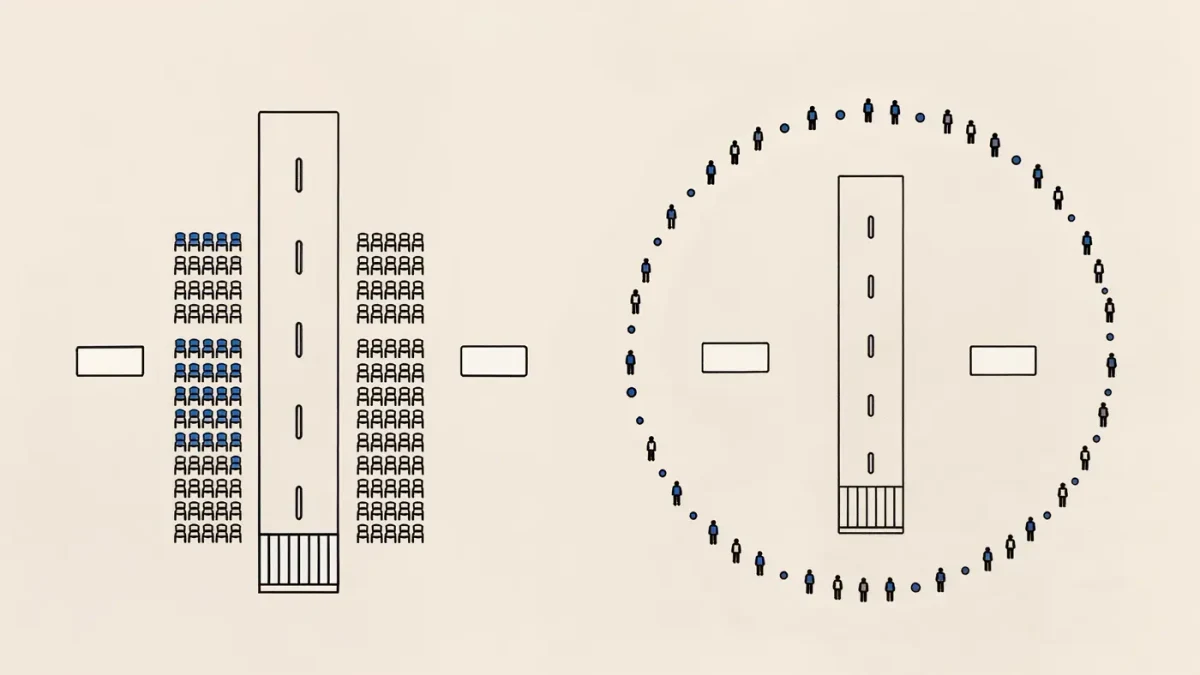
Is the seated runway show disappearing? Not disappearing, but losing its monopoly. A growing share of New York's most talked-about presentations now seat no one: guests stand in a ring around the runway, arrive in waves, or watch on screens entirely. The shift is often described as democratization, and the label is half right. Standing formats redistribute attention — but they also serve harder interests: content capture, venue economics, and a guest list the brand controls more tightly than any seating chart allows.
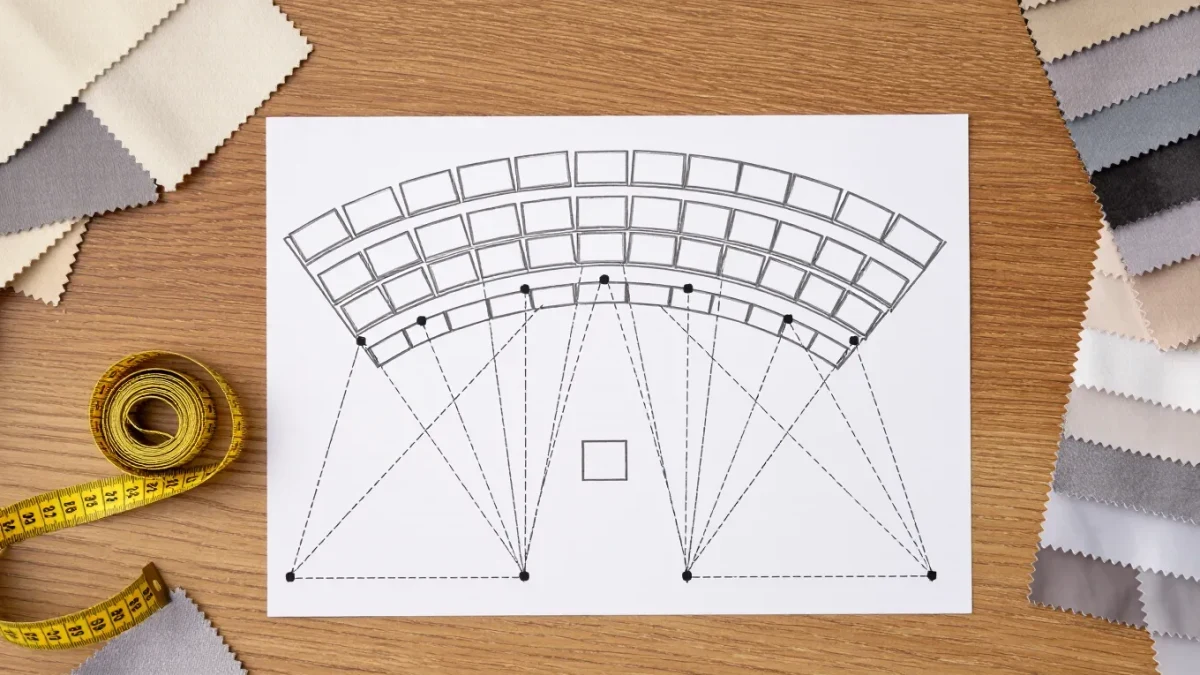
The traditional layout — a raised catwalk flanked by rows of numbered chairs, first row reserved, back rows by descending rank — encodes a hierarchy so legible that seating charts were once read like diplomatic cables. Standing shows erase the map. No name cards, no grade of seat, no visible pecking order. Everyone's sightline is equally compromised, which is either equality or chaos depending on where you're standing.
Why would a brand give up its seats?
Three practical reasons outweigh the romance of the front row. First, content: standing audiences photograph and film freely, and a crowd of raised phones generates more social output than a seated room ever did — the guests become the media plan. Second, capacity: standing-room layouts fit more bodies into the same floor, and a show the internet will watch anyway gains nothing from a half-empty rope line. Third, control through ambiguity: in a seated show, the chart tells you exactly where you rank. In a standing crowd, nobody knows — and brands have learned that a guest who can't locate their own status will work harder for it.
Then there is the argument the brands actually say out loud: accessibility. Opening show attendance to students, community members, and fans — often via raffles or public ticketing — reframes the show from private trade event to public culture, and the standing layout supports it structurally. Livestreams pushed this logic further; once the real audience is online, the physical room is just the studio, and rigging it like a throne room starts to look like nostalgia. Data from the cultural sector consistently documents how audiences for live events expanded their digital expectations over the past decade, and fashion's room design has followed.
| Seated show | Standing show | |
|---|---|---|
| Status legibility | Explicit; the chart is the message | Ambiguous; rank suspended |
| Capacity | Lower; fixed by chair count | Higher; density limited only by safety |
| Content output | Controlled; pro cameras lead | Amplified; every guest films |
| Buyer experience | Structured; appointments around it | Fluid; sightlines uncertain |
| Symbolic claim | Hierarchy, craft, permanence | Access, energy, now |
Is it really democracy, though?
Partially, and the honest answer requires reading who is in the room, not just how they're arranged. A standing crowd drawn from a raffle is more open than a first row of allocated seats. But the standing format can also mask exclusivity rather than dissolve it: when everyone stands, invitation politics move off the floor and into the guest list, where they are harder to photograph and harder to critique. The democratization is real at the point of entry — public tickets, open streams, campus partnerships — and thinner at the point of access that matters commercially, the after-show conversations where orders and opportunities actually circulate.
There is also a craft argument for chairs that the industry keeps rediscovering. Seating disciplines attention. A seated audience watches the clothes the way a buyer needs to: unhurried, frontal, sustained. For collections built on tailoring and detail, the chair is a design tool. This is why the two formats now coexist as rhetorical choices rather than an evolutionary march — a heritage house asserting continuity seats its guests; a youth brand claiming disruption fills a Bushwick warehouse with a mosh pit in nicer shoes.
Which format wins?
Neither, permanently — and that equilibrium is itself the story. The layout is now part of the collection's sentence, chosen the way a soundtrack is chosen: to say something the clothes cannot. What has genuinely changed is that the default broke. A brand must now decide how its audience stands, sits, or streams, and each answer publishes a position on who the house belongs to. Federal data on spectatorship and attendance across the live-events economy underlines the backdrop: the paying, streaming, phone-wielding public has barged into rooms that were once closed, and no velvet rope has held since.
When everyone stands, nobody knows where they rank. Some guests call that freedom. Publicists call it chaos.
The history is shorter than it looks. Standing shows were born twice: once in the early nineties, when downtown designers rejecting the trade-show formality staged raves with clothes in it, and again in the mid twenty-tens, when social-first brands realized a seated room was an obstacle to the content they actually wanted. Each wave framed itself as liberation, and each was partly a budget position dressed as ethics — chairs, risers, and ushers cost money, and a crowd costs nothing. That does not make the democratization fake. Movements in fashion are almost never pure, and the good ones are usually profitable first. The standing show's honest genealogy is both: a real widening of the gate, riding on top of an economy that benefited from the same gesture.
The first row had a good run — a century of name cards, diplomacy, and mythology. It is not going away. But it has become one option in a menu, and the room now asks a question chairs never had to: not who sits closest, but who is the show actually for. The honest brands answer with the floor plan.